
 ";
";
Porsche · digital presskit
Another feature that is typical of a Porsche sports car is a lightweight concept with optimal weight distribution and a low centre of gravity. The battery mounted in the car's underbody, which is based on the latest lithium-ion technology, runs the whole length between the front and rear axles.
This distributes its weight to the two drive axles uniformly, resulting in exceptionally good balance. In addition, it makes the sports car's centre of gravity extremely low. Both of these factors significantly boost performance and a sports car feeling. The body as a whole is made up of a functional mix of aluminium, steel and carbon fibre reinforced polymer. The wheels are made of carbon: the Mission E has wide tyres mounted on 21-inch wheels in front and 22-inch wheels at the rear.
Design: fascinating sports car with Porsche DNA
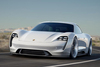
Every square inch, every angle, every radius of the Mission E reflects one thing above all else: emotional sportiness in the best tradition of Porsche design The starting point is the sculpture of a sport saloon with a low height of 130 cm with sports car attributes from Zuffenhausen that embodies visible innovations such as its integrated aerodynamics. Distinctive air inlets and outlets – on the front, sides and at the rear – typify the body's full flow-through design that enhances efficiency and performance. Integrated air guides improve airflow around the wheels, for instance, and air outlets on the sides reduce overpressure in the wheel wells, thereby reducing lift.
The much reduced sculpting of the front end shows a classic Porsche sweepback, and it relates the concept car to the 918 Spyder and Porsche race cars. A new type of matrix LED headlights in the brand's typical four-point light design captures the viewer's gaze. Integrated as an element hovering in the airflow of the air inlet, they lend a futuristic character to the front end. The four LED units are grouped around a flat sensor for assistance systems whose border serves as an indicator light. Distinctive front wings and an extremely low-cut bonnet reference 911 design. As in the 911 GT3 RS, a wide characteristic recess extends from the overlapping front luggage compartment lid up and over the roof. The line of the side windows is also similar to that of the 911, however, with one important difference: two counter-opening doors enable convenient entry – without a B-pillar. Another difference: instead of the classic door mirror, inconspicuous cameras are mounted on the sides that contribute to the car's exceptional aerodynamics.
The rear design underscores the typical sports car architecture. The lean cabin with its accelerated rear windscreen, which draws inward at the rear, creates space for the sculpted shape of the rear wings that only a Porsche can have. A three-dimensional “PORSCHE” badge illuminated from inside hovers beneath an arch of light that extends across the entire width in a black glass element.
Interior: light and open with four single seats
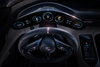
The interior of the Mission E transfers all of the traditional Porsche design principles into the future: openness, purist design, clean architecture, driver orientation and everyday practicality. The all-electric drive concept made it possible to fully reinterpret the interior. The lack of a transmission tunnel, for instance, opens up space and gives a lighter and more airy atmosphere to the entire interior. Race bucket seats served as inspiration for the four single seats. Their lightweight design is weight-saving, and it gives occupants secure lateral support during dynamic driving. Between the front seats, the centre console – elegantly curved like a bridge with open space beneath it – extends up to the dashboard.
More articles of Porsche Mission E
Press film
Concept Study: Mission E
At Porsche, innovations and developments that have proved themselves under extreme racing conditions always benefit production models, too. more ...