

Sprints faster while offering 12 percent better fuel economy
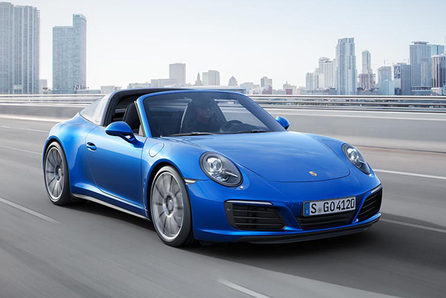
Thanks to bi-turbo charging, the three-liter six-cylinder engines in the 911 Targa 4 attain a power of 370 hp (272 kW) and a torque of 450 Nm; in the S model, power output increases to 420 hp (309 kW) and torque to 500 Nm. This means that the driver can convert an extra 20 hp (15 kW) of dynamic performance into driving pleasure in both models. The higher power output of the S engine is obtained from turbochargers with modified compressors, a customized exhaust system and special tuning of the engine management system.
In combination with the new electro-hydraulically controlled all-wheel drive system, the new Targa models attain even better acceleration figures. When equipped with the PDK and Sport Chrono Package options, the 911 Targa 4 sprints from zero to 100 km/h in 4.3 seconds (0.5 s faster than the previous model) and the S model in 4.0 seconds (0.4 s faster). Top speeds range between 287 km/h and 303 km/h, depending on the model and equipment.
Traditionally, each new generation of Porsche engines offers more power along with better fuel economy. Fuel consumption of the 911 Targa 4 with PDK, for instance, has been reduced by 0.8 liters to 7.9 l/100 km. Even greater savings have been realized in the 911 Targa 4 S with PDK; its combined fuel consumption was reduced by 1.2 liters to 8.0 l/100 km.
Inherited from the 918 Spyder: Sport Chrono Package with mode switch
For the first time, in conjunction with the optional Sport Chrono package, the new 911 models have a driving dynamics switch on the steering wheel that was derived from the 918 Spyder. This mode switch consists of a rotary ring with four positions for the Normal, Sport, Sport Plus and Individual driving modes. Depending on the installed options, the latter mode lets drivers configure their own vehicle setups, for instance with settings for the PASM, active engine mounts, PDK shifting strategy and sport exhaust system. In conjunction with the PDK transmission, the mode switch has an extra button known as the Sport Response Button. When it is activated, the drivetrain is preconditioned for the best possible acceleration over a 20-second period, such as for upcoming passing maneuvers. This involves engaging the optimal gear and temporary modification of the engine management parameters and the all-wheel drive system for even more spontaneous response.