

Porsche · digital presskit
New generation of 911 Carrera engines
Performing under pressure: hHigher performance and better fuel economy by forced induction
Superior power even from low revs, spontaneous power development up into the highest rev ranges and yet significantly better fuel economy: that is how the brand new generation of engines for the new 911 Carrera noticeably increases driving pleasure.
370 hp (272 kW) of power at the rear of the 911 Carrera is waiting to be unleashed and converted into sporty propulsion. The engine of the 911 Carrera S has a power output of 420 hp (309 kW). Both engines have gained 20 hp (15 kW) of power. The torque gains are even more impressive: With 450 Nm in the 911 Carrera and 500 Nm in the 911 Carrera S, the maximum torques of both engines have increased by 60 Nm. Meanwhile, the driver not only benefits from the boosted maximum torque figures; the full torque is already available from 1,700 rpm to be converted into sprinting power. The maximum torque is available over the entire range up to 5,000 rpm. At the same time, the new generation of engines is significantly more fuel-efficient. Fuel consumption has been reduced by up to one litre per 100 km, depending on the version. The 911 Carrera with PDK transmission now consumes just 7.4 litres of fuel per 100 km (0.8 l less per 100 km), while the 911 Carrera S with PDK consumes 7.7 l/100 km (1.0 l less per 100 km).
911 Carrera S: more power by innovative turbo technology
The new generation of six-cylinder flat engines owes its significantly extended spread between performance and fuel efficiency to an ingenious bundle of technical advances. For the first time, Porsche is also implementing biturbo charging in the 911 Carrera engines, continuing a success story that began in 1974 with the market launch of the top 911 Turbo model. The technology, which was developed in motorsport and led to numerous victories there, has since been implemented in all top Porsche models, and enabled each generation to reach new record figures for power and fuel economy. One advantage of the turbocharged engine concept lies in its higher specific power. This makes it possible to achieve the same power as a naturally aspirated engine with less engine displacement. Therefore, Porsche reduced engine displacement to three litres in both new 911 Carrera models. The greater power of the 911 Carrera S results from turbochargers with modified compressors, a model-specific exhaust system and specially tuned engine management. Both power versions reach their nominal power at 6,500 rpm, and the usable speed range extends to 7,500 rpm. These are the characteristic data of exceptionally free-revving sports car engines.
Forced induction requires an entirely new airflow system at the rear of the 911 Carrera – both for the combustion air and for intercooling. The engine gets its combustion air centrally in front of the rear spoiler. From two lateral ports on the air filter box, the airflow reaches two induction channels to the lower-mounted turbochargers. The air that is compressed and thereby heated by the turbochargers then flows through two intercoolers located laterally behind the wheel arches and then into the engine's induction manifold via the throttle flap. Two other ducts guide the air for cooling the heated combustion air –also from the air screen in the rear lid – to the intercoolers.
More articles of Engine and drivetrain
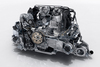
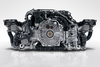
Turbo engines from Porsche
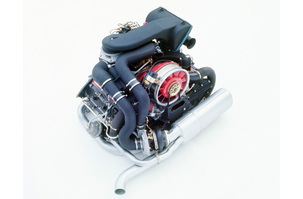
Turbo technology is Porsche technology. Further development of the 911 Carrera engines into the new engines with turbocharging was a logical next step. Over decades, Porsche had cultivated the turbocharged engine to offer its unique spread between power and efficiency that was unattainable in conventional naturally-aspirated engines. more ...