
Porsche · digital presskit
Intelligent overrun cut-off and extended automatic stop-start system
Intelligent overrun cut-off occurs in such situations as when the driver takes the foot off the accelerator pedal on a motorway descent. First, the drive control system switches to what is referred to as a coasting mode with open clutches and the engine idling.
If the car's speed still increases, intelligent overrun cut-off is activated which engages the clutch and shuts off the engine. The automatic stop-start system has also learned to interrupt the flow of fuel early when rolling to a stop. The new functions lead to further improved fuel economy – automatically and without the driver noticing changes in the car's handling.
The virtual intermediate gears have the same fuel-saving effect. They have already proven themselves in the 911 Turbo. They are used to reduce revs during quieter modes of driving, if shifting to the next higher gear would drop revs below the engines lower rev limit. To do this, the transmission controller engages adjacent gear levels, controls both clutches for defined slip and transmits the drive power in this way. When the driver accelerates, the dual clutch gearbox downshifts to the suitable gear with lightning speed. Since the PDK has oil bath clutches, this innovative transmission function is wear-free.
From the 918 Spyder: mode switch on steering wheel for Sport Chrono Package
In conjunction with the optional Sport Chrono Package, the 911 Carrera now has a mode switch on the steering wheel for the first time, derived from the hybrid mode switch of the 918 Spyder. The mode switch consists of a ring that can be turned to four 90-degree positions for the driving modes “Normal”, “Sport”, “Sport Plus” and “Individual”. Depending on the equipment, the latter setting enables drivers to configure their own individual vehicle set-up, e.g. of the PASM, active engine mounts, PDK shifting strategy and sports exhaust system. An LED integrated in the rotary switch shows the currently selected mode. The sports cars with the dual clutch gearbox also adopt the central pushbutton switch from the 918 Spyder, which the driver can use to precondition the drive and chassis control systems for enhanced performance and even faster response – e.g. during overtaking manoeuvres. The engine and PDK transmission parameters are pre-set for a period of 20 seconds to achieve the best possible acceleration. An indicator in the cockpit informs the driver of the enhanced sprinting readiness and how much longer it will last.
This is how a sports car should sound: passionate sound inside and out
The new 911 Carrera models have not only made gains in power and efficiency. Forced induction also makes the sound characteristic of the engine and exhaust system more varied, both outside and inside the car. A sound duct – which is individually tuned for each model version – transmits the induction sound into the interior. The transition from naturally aspirated operation during idle to charging with building revs extends the fullness of engine sound impressively. The exhaust systems deliver the matching sound. The 911 Carrera has a main silencer with two oval tailpipes. The S model additionally has two integrated exhaust flaps and dual tailpipes. The new sport exhaust system (also switched) is available as an option. Its characteristic elements are two round dual tailpipes that for the first time are centrally located, and of course an incomparably sporty sound. By the way, this sound is not digitally modified, and it also enables a very quiet and discreet driving style for relaxed cruising.
More articles of Engine and drivetrain
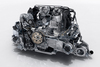
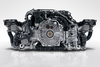
Turbo engines from Porsche
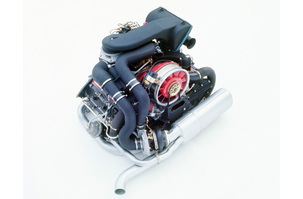
Turbo technology is Porsche technology. Further development of the 911 Carrera engines into the new engines with turbocharging was a logical next step. Over decades, Porsche had cultivated the turbocharged engine to offer its unique spread between power and efficiency that was unattainable in conventional naturally-aspirated engines. more ...