

Porsche · digital presskit
The chassis of the new 911 Carrera
Lower, faster, more comfortable – and optionally also available with rear axle steering
The 911 Carrera is the original all-round sports car, and for over five decades, it has been the reference for driving dynamics. With each new generation, Porsche further increases the spread between everyday comfort and circuit performance.
This generation is no exception. The new standard chassis – with its ten millimetre lower ride height and PASM (Porsche Adaptive Suspension Management) – lowers the centre of gravity for even better cornering stability, and the further developed adaptive dampers provide even more sensitive control. The agility and stability benefits realized by active rear axle steering – now being offered as an option for the first time in the 911 Carrera S – are significant. At the same time, it improves handling by reducing the turning circle. This innovative technology has already proven itself in the current 911 Turbo and 911 GT3 models. Porsche is also further enhancing the active safety of this classic sports car by offering the automatic post-collision braking system as standard.
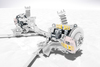
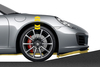
Despite being considerably more comfortable than the previous model, the handling of the new 911 Carrera reaches a higher level of sportiness. Thanks to a new generation of active PASM dampers with broader characteristic spreads, the body connection is further improved during dynamic driving, as is the responsiveness on uneven road surfaces. Rebound buffer springs at all four wheel suspensions not only reduce the tendency to roll and pitch, especially during sporty driving, but also improve rebound response. The new chassis tuning also encompasses modified main springs and anti-roll bars. The width of the rear tyres was increased by half an inch to 11.5 inches. Together with the tyre industry, Porsche has developed a new generation of tyres for the 911 Carrera that exhibits much better performance in dry handling and braking as well as optimised wet driving properties. A sport chassis is available as an option; it lowers the ride height by ten millimetres compared to the new standard chassis, yet also offers significantly better comfort due to its new tuning.
More articles of Chassis
Turbo engines from Porsche
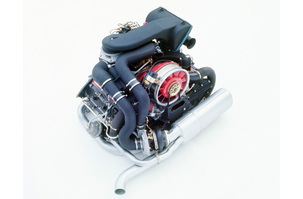
Turbo technology is Porsche technology. Further development of the 911 Carrera engines into the new engines with turbocharging was a logical next step. Over decades, Porsche had cultivated the turbocharged engine to offer its unique spread between power and efficiency that was unattainable in conventional naturally-aspirated engines. more ...