

Porsche · digital presskit
When equipped with the optional active rear axle steering, the 911 Carrera S takes a big step closer to the excellent cornering dynamics of the 911 Turbo and the 911 GT3. The 911 shows significant improvements in agility in tight bends, in stability in high-speed lane changes and in manoeuvrability in city traffic.
If the driver turns into a bend at speeds under 50 km/h, the front and rear wheels turn in opposite directions. This leads to what is known as virtual wheelbase shortening. The sports car can be guided through the bend effortlessly with smaller steering wheel inputs. The 911 with rear axle steering feels like a compact car when manoeuvring. Its turning circle is reduced by 0.5 metre to 10.7 metres. The approach is different for fast lane-changes at high speed. Starting at around 80 km/h, the front and rear wheels are turned in the same direction, giving the feeling that the sports car has a longer wheelbase. For the driver this means greater stability and more spontaneous and harmonious initiation of a change in direction due to the faster build-up of lateral forces at the rear axle.
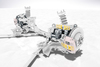
The active rear-wheel steering comprises two electro-mechanical actuators on the left and right sides of the rear axle instead of the conventional control arms. These allow the steering angle of the rear wheels to be varied by up to around two degrees, depending on vehicle speed. By comparison, a steering angle of two degrees at the front wheels is comparable to turning the steering wheel 32 degrees from the centre position. The high lateral force potential of the steered rear axle made it possible to modify front axle steering to be ten percent more direct, which noticeably enhances agility even more.
Automatic post-collision braking system reduces severity of accidents
The automatic post-collision braking system is being used in a Porsche sports car for the first time in the new 911 Carrera. The system can reduce the severity of a secondary collision by automatically braking the vehicle after the initial collision. The automatic post-collision braking system is triggered when the airbag sensors detect a collision of a specific severity. Then the system autonomously initiates braking at a maximum deceleration rate of 0.6 g. The driver can override the post-collision braking system at any time. Its functionality is deactivated when the driver presses the accelerator pedal, for instance. It is also deactivated if the driver initiates hard braking at an even higher rate of deceleration. The assistance system generally applies the brakes until a residual vehicle speed of ten km/h is reached.
More articles of Chassis
Turbo engines from Porsche
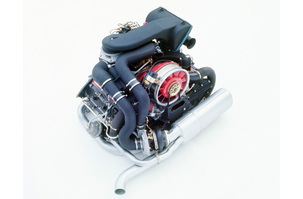
Turbo technology is Porsche technology. Further development of the 911 Carrera engines into the new engines with turbocharging was a logical next step. Over decades, Porsche had cultivated the turbocharged engine to offer its unique spread between power and efficiency that was unattainable in conventional naturally-aspirated engines. more ...