
Porsche · digital presskit
Seventh generation Porsche 911 Carrera
Innovative turbocharged engines, an advanced chassis, new Porsche Communication Management (PCM)
The 911 Carrera has been one of the world's best-selling sports cars for decades. Now the new generation has arrived to further extend this lead. The new 911 is exceedingly well equipped to do this with innovative turbocharged flat engines, an advanced chassis that offers an even greater spread between performance and comfort and a new infotainment system.
Thanks to over four decades of experience with turbo engines – in both motor racing and production sports cars – the engines of the new 911 Carrera set the benchmark in terms of performance, driving pleasure and efficiency. The rear-axle steering that is available for the first time as an option in the Carrera S extends the range of driving dynamics emphatically.
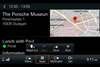
Many exterior features of the 911 Carrera have been visually refined. They range from headlights with four-point daytime running lights to door handles without recess covers, a redesigned rear lid with vertical louvres and new rear lights. Inside, the new standard Porsche Communication Management (PCM) system with a multi-touch display offers a considerably expanded range of functions and greatly simplified operation.
New turbocharged engines: 20 hp more power with better fuel economy
The completely new engine generation with bi-turbo charging boosts driving pleasure in the 911 Carrera, making it an even more intense experience. 370 hp (272 kW) of power at the rear of the 911 Carrera is waiting to be unleashed and converted into sporty propulsion. The engine in the 911 Carrera S now delivers 420 hp (309 kW). In both cases, this represents a power increase of 20 hp (15 kW). Both engines have three litres of displacement. The greater power of the 911 Carrera S comes from turbochargers with modified compressors, a specially designed exhaust system and engine management tuning.
The new Porsche engines are characterised by significantly increased torque (60 Nm in each case) with maximum torque of 450 Nm and 500 Nm, respectively, delivered constantly from a low 1,700 rpm up to 5,000 rpm in both cases, thus ensuring excellent driving performance. At the same time, the maximum speed of 7,500 rpm in the new engine generation clearly exceeds the top speeds of conventional turbocharged engines – and it is underscored by typical sonorous Porsche engine sound.
Every new 911 generation also impresses with enhanced performance and efficiency compared to the previous generation. For example, depending on the model variant, the new engine generation is almost twelve percent more efficient: fuel consumption is reduced by up to a litre per 100 kilometres. The 911 Carrera with PDK transmission now consumes just 7.4 litres of fuel per 100 km (0.8 litre less), while the 911 Carrera S with PDK consumes 7.7 l/100 km (1.0 litre less).
The new 911 also boasts impressive performance: the 911 Carrera Coupé with Porsche Doppelkupplung (PDK) and Sport Chrono Package sprints from zero to 100 km/h in 4.2 seconds – making it two tenths of a second faster than its predecessor. The 911 Carrera S with PDK and Sport Chrono Package completes its showcase discipline in just 3.9 seconds (also 0.2 s faster). This means that it is the first 911 in the Carrera family to undercut the magic four-second mark. And the top speeds of both models have also been increased further: the 911 Carrera now has a top speed of 295 km/h (a six km/h increase), while the 911 Carrera S now even reaches 308 km/h (an increase of four km/h).
In conjunction with the optional Sport Chrono Package the 911 Carrera now has a mode switch on the steering wheel for the first time, derived from the hybrid mode switch of the 918 Spyder. The mode switch consists of a rotary ring with four positions for the driving modes “Normal”, “Sport”, “Sport Plus” and “Individual”. Depending on the equipment, the latter setting enables drivers to configure their own individual vehicle set-up, for example the PASM, active engine mounts, PDK shifting strategy and sports exhaust system. In combination with the PDK transmission, the mode switch has an additional push button, the “Sport Response Button”. When this button is pressed, the drivetrain is pre-conditioned for maximum acceleration for 20 seconds, for example before overtaking manoeuvres. In this mode, the optimal gear is engaged and engine management is adjusted for even more spontaneous response for a brief period of time.
More articles of Short and snappy
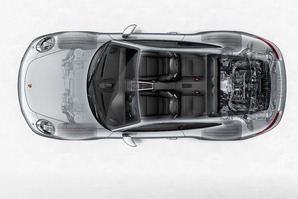
The 911 Carrera is the brand icon of Porsche. Powered by bi-turbo engines for the first time, it sets new benchmarks in performance and efficiency. The further developed chassis – with standard active damping (PASM) and a ten millimetre lower ride height – delivers an even broader spread of characteristics between sporty and comfortable. more ...