
Porsche · digital presskit
New generation 911 Carrera engines
Performing under pressure: higher performance and better fuel economy by forced induction
Superior power even from low revs, spontaneous power development up into the highest rev ranges and yet significantly better fuel economy: that is how the completely new generation of engines adds a clearly perceptible boost to driving pleasure in the new 911 Carrera generation. 370 hp (272 kW) of power is waiting to be unleashed and converted into sporty propulsion at the rear of the 911 Carrera. The engine of the 911 Carrera S has a power output of 420 hp (309 kW). The power of both engines was increased by 20 hp (15 kW).
The torque gains are even more impressive. At 450 Nm in the 911 Carrera and 500 Nm in the 911 Carrera S, the maximum torques of both engines have increased by 60 Nm. Meanwhile, the driver not only benefits from the boosted maximums but also from the full torque being available to be converted into sprinting power from a low 1,700 rpm. The maximum torque is available over the entire range up to 5,000 rpm. At the same time, the new generation of engines is significantly more fuel-efficient. Fuel consumption has been reduced by up to one litre per 100 km, depending on the version. The 911 Carrera with PDK transmission now consumes just 7.4 litres of fuel per 100 km (0.8 litre less per 100 km), while the 911 Carrera S with PDK consumes 7.7 l/100 km (1.0 litre less per 100 km).
911 Carrera S: more power with larger turbochargers
The new generation of six-cylinder flat engines owes its significantly extended spread between performance and fuel efficiency to an ingenious bundle of technical advances. For the first time, Porsche is using engines with bi-turbo charging in the 911 Carrera. One advantage of the turbocharged engine concept lies in its higher specific power. This made it possible to reduce engine displacement to three litres in both new 911 Carrera models. The greater power of the 911 Carrera S results from turbochargers with modified compressors, a model-specific exhaust system and specially tuned engine management. Both power versions reach their nominal power at 6,500 rpm, and the usable speed range extends up to 7,500 rpm. These are the characteristic data of exceptionally free-revving sports car engines.
Forced induction requires an entirely new airflow system at the rear of the 911 Carrera for both the combustion air and intercooling air. The engine gets its combustion air centrally in front of the rear spoiler. The air flows from two lateral ports on the air filter box into two induction channels that lead to the lower-mounted turbochargers. The turbochargers compress and thereby heat the air which then flows through two intercoolers located laterally behind the wheel arches and then into the engine's induction manifold via the throttle flap. Two other ducts guide the air for cooling the heated combustion air –also from the air screen in the rear lid – to the intercoolers.
New cylinder head with central injector and variable exhaust camshaft
In-depth modifications to the base engine further increase the six-cylinder engine's spread between sporty power reserves and exemplary efficiency. The new central position of the injector improves combustion, which has direct positive effects on fuel economy and emissions quality. Two fuel pumps – one per cylinder bank – supply the petrol direct-injection unit with a system pressure of up to 250 bar. Moreover, an adjustable exhaust camshaft makes it possible to control the charge exchange process even more precisely. On the intake side, Porsche continues to use the proven Vario Cam Plus, which variably adjusts both valve lift and valve opening duration. Another advantage of the dual-side, adaptive valve train with reduced friction: it enables even finer adjustment of the turbocharged engine's sporty, spontaneous response at low revs that is typical of a Porsche.
More articles of Engine and transmission
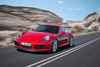
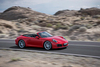
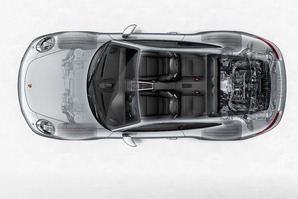
The 911 Carrera is the brand icon of Porsche. Powered by bi-turbo engines for the first time, it sets new benchmarks in performance and efficiency. The further developed chassis – with standard active damping (PASM) and a ten millimetre lower ride height – delivers an even broader spread of characteristics between sporty and comfortable. more ...
Engine and Powertrain
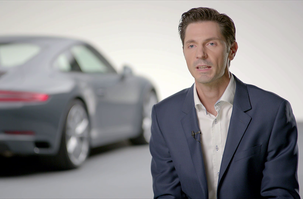
Thomas Brandl, Manager Powertrain Product Line 911, about the 911 Carrera's engine and powertrain more ...