

Porsche · digital presskit
Chassis of the new 911 Carrera
Lower, faster, more comfortable – and optionally with rear-axle steering
The 911 Carrera is the original all-round sports car, and for over five decades it has been the reference for driving dynamics. With each new generation, Porsche further increases the spread between everyday comfort and circuit track performance.
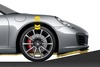
This generation is no exception. The new standard chassis – with its ten millimetre lower ride height and PASM (Porsche Adaptive Suspension Management) – lowers the centre of gravity for even better cornering stability, and the further developed adaptive dampers provide even more sensitive control. The agility and stability benefits realised by active rear-axle steering – which is now being offered as an option for the first time in the 911 Carrera S – are substantial. At the same time, it improves handling by reducing the turning circle. The effectiveness of this innovative technology has already been proven in the current 911 Turbo and 911 GT3 models. Porsche is also further enhancing active safety in this classic sports car by offering the automatic post-collision braking system as standard.
The new 911 Carrera takes sportiness one level higher while simultaneously being considerably more comfortable than the previous model. Thanks to a new generation of active PASM dampers with broader characteristic spreads, the car body connection is further improved during dynamic driving, as is responsiveness on uneven road surfaces. Rebound buffer springs at all four wheel suspensions reinforce both of these properties: they not only reduce the tendency to roll and pitch, especially during sporty driving, but also improve rebound response. The new chassis tuning also includes modified main springs and anti-roll bars. The width of the standard rear tyres was increased by half an inch to 11.5 inches. Working together with the tyre industry, Porsche has developed a new generation of tyres for the 911 Carrera that exhibits much better performance in dry handling and braking as well as optimised wet driving properties. A sport chassis is available as an option; it lowers the ride height by ten millimetres compared to the new standard chassis, yet it also offers significantly better comfort due to its new tuning. For drivers with even sportier aspirations, Porsche Dynamic Chassis Control (PDCC) – an active roll compensation system – is available as an option..
Optional rear-axle steering enhances cornering dynamics
When equipped with the optional active rear-axle steering, the 911 Carrera benefits from the excellent cornering dynamics of the 911 Turbo and the 911 GT3. The 911 shows significant improvements in agility in tight bends, stability in high-speed lane changes and manoeuvrability in city traffic. If the driver turns into a bend at speeds under 50 km/h, the front and rear wheels turn in opposite directions. This leads to what is known as virtual wheelbase shortening. The sports car can be guided through the bend effortlessly with smaller steering wheel inputs. The 911 with rear-axle steering feels like a compact car when manoeuvring. Its turning circle is reduced by 0.4 metre to 10.8 metres. The approach is different for fast lane-changes at high speed. Starting at around 80 km/h, the front and rear wheels are turned in the same direction, giving the feeling that the sports car has a longer wheelbase. For the driver this means greater stability and more spontaneous and harmonious initiation of a change in direction due to the faster build-up of lateral forces at the rear axle.
Automatic post-collision braking system reduces severity of accidents
In the new 911 Carrera, the automatic post-collision braking system is making its debut in a Porsche sports car. The system can reduce the severity of a secondary collision by automatically braking the vehicle after an initial collision. The automatic post-collision braking system is triggered when the airbag sensors detect a collision of a specific severity. Then the system autonomously initiates braking at a maximum deceleration rate of 0.6 g. The driver can override the automatic post-collision braking system at any time. Its functionality is deactivated when the driver presses the accelerator pedal, for instance. It is also deactivated if the driver initiates hard braking at an even higher rate of deceleration. Essentially, the assistance system applies the brakes until a residual vehicle speed of ten km/h is reached.
More articles of Chassis

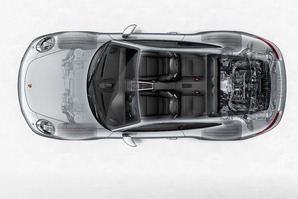
The 911 Carrera is the brand icon of Porsche. Powered by bi-turbo engines for the first time, it sets new benchmarks in performance and efficiency. The further developed chassis – with standard active damping (PASM) and a ten millimetre lower ride height – delivers an even broader spread of characteristics between sporty and comfortable. more ...
Chassis and Performance
Eberhard Armbrust, Manager Vehicle Dynamics, about the 911 Carrera's chassis and performance more ...