
Porsche · digital presskit
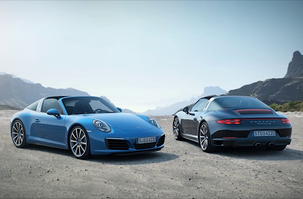
The 911 Targa 4 will appeal to special tastes in individual sports car driving pleasure with its sophisticated design, unique roof design and sporty all-wheel drive. The new generation further intensifies the charm of the original. The innovative turbo engines output more power and consume less fuel, while the further advanced all-wheel drive system boosts the car's driving dynamics and active safety.
Another feature providing for a greater spread between sporty performance and comfort is the standard adaptive PASM (Porsche Active Suspension Management) chassis system that lowers the car's ride height by ten millimeters. Rear axle steering, which is offered as an option for the 911 Targa 4S for the first time, substantially enhances the driving dynamics spectrum. The new standard Porsche Communication Management (PCM) connectivity and infotainment system offers extended functionality, simplified operation and a multi-touch monitor. Since making its debut in 1965, the Targa has held a solid position within the Porsche 911 family, and it represents around 13 percent of all 911 cars ever sold.
With its individual design, the new 911 Targa continues to clearly set itself apart from the Coupé and Cabriolet. It combines the classic Targa idea with state-of-the-art roof convenience. Like the legendary original Targa, the current generation has a characteristic wide rollover protection bar instead of B-pillars, a movable roof section above the front seats and a wrap-around rear window without C-pillars. The roof section can be opened or closed at the push of a button, and when opened, the roof element is stored behind the rear seat system.
The further refined look of the 911 accentuates the sophisticated elegance of the 911 Targa. The light bar between the taillights, for instance, now has a pronounced three-dimensional, sculptural appearance. This visual depth effect is intensified when the light is switched on. The light bar also accentuates the typical proportions of the all-wheel drive 911, whose rear fenders flare further outward by 44 millimeters, just like on the previous all-wheel-drive models... Other distinguishing characteristics of the new 911 generation range from the headlights with four-point daytime running lights to the door handles without recess covers and the newly designed rear lid with its vertical louvers and new tail lights – including signature four-point brake lights.
More articles of Porsche 911 Targa 4