 ";
";
Porsche · digital presskit
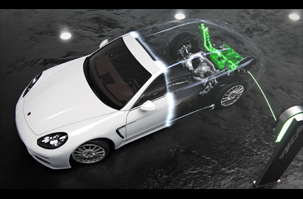
The Cayenne S E-Hybrid is the first plug-in hybrid in the luxury SUV segment. In addition to the internal combustion engine as the main source of propulsion, the most important components are an electric motor integrated into the power train, the powerful lithium-ion battery and the plug-in technology.
Another key element is the disengagement clutch between internal combustion engine and electric motor. It works so smoothly that driver and occupants do not notice the internal combustion engine being engaged and disengaged.
With the internal combustion engine switched off, it starts whenever the driver wishes: if he or she consciously exceeds the noticeable pressure point when pushing down on the accelerator pedal, the engine starts up instantly, comes immediately up to speed, the disengagement clutch closes and the full accelerating force of both motors is available to the driver without practically any delay.
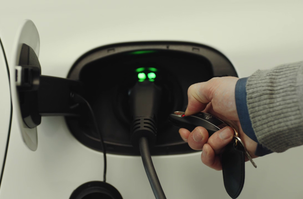
In the Cayenne S E-Hybrid the drive system concept has been further developed and optimised for use in an SUV. Two important differences are a high-voltage battery with a greater energy capacity of 10.8 kWh (Panamera S E-Hybrid: 9.4 kWh) and, offered as an optional extra for the Cayenne S E-Hybrid, a charger with a higher power level of 7.2 kW. This gives total flexibility: if it is connected to the domestic mains, it works like the standard charger in 3.6-kW mode and fully charges the battery in around three and a half hours. If you plug it into a high-voltage connection, it works in 7.2-kW mode and has the battery fully charged in under 90 minutes.
The lithium-ion battery's case is identical to the one in the Panamera S E-Hybrid – this is part of Porsche's modular strategy and geared to enabling the use of components across multiple model generations. However, via new cells with a greater capacity of 28 Ah each (in the Panamera S E-Hybrid: 24 Ah) the high-voltage battery benefits from the latest advances in rechargeable battery technology and its greater capacity helps the Cayenne to achieve an identical electric range of 18 to 36 kilometres, depending on driving style and topography. The improved battery thus compensates, for example, for the greater weight and driving resistance levels of the Cayenne compared to the Panamera.
A direct comparison of the Cayenne S E-Hybrid with its predecessor, the Cayenne S Hybrid, underlines the progress. The previous vehicle had a nickel-metal hydride battery with an energy content of 1.7 kWh and no plug-in concept. The electric motor's power output has more than doubled from 34 kW (46 hp) to 70 kW (95 hp). Total fuel consumption is now 3.4 l/100 km (NEDC) instead of the previous 8.2 l/100 km, which equates to CO2emissions of 79 g/km. On the old model it was 193 g/km of CO2. It goes without saying that the Cayenne S E-Hybrid complies with the Euro-6 emissions standard.
The supercharged three-litre V6 engine and electric motor's total combined power output of 416 hp and total torque of 590 Nm in the Cayenne S E-Hybrid facilitate driving performance levels of sports car standard: nought to 100 km/h in 5.9 seconds and a top speed of 243 km/h. The electric top speed is 125 km/h.
For the transmission of power Porsche uses the proven Tiptronic S. The eight-speed automatic gearbox features additional functions for use in a parallel full hybrid vehicle. Due to the modified e-motor characteristics, a dedicated gear-change strategy is, for example, implemented for the E-Power mode. In all-electric mode the vehicle drives across the full relevant speed range at an rpm level that compared to the hybrid mode is higher and thus optimised for effectiveness. In Sport mode a hybrid-specific gear-change strategy is also available.
Cayenne S E-Hybrid owners remain connected to their vehicle via the standard Porsche Car Connect system: via smart phone it enables data such as the charge level or energy efficiency figures to be accessed and the optional auxiliary climate control system to be controlled. The latter cools and heats the vehicle interior with the ignition switched off – to get it to the right temperature ahead of the journey, while the vehicle is still connected to the mains. No energy is therefore used for this on the move and the electric range thus increases.
More articles of Porsche Cayenne S E-Hybrid /
Porsche Panamera S E-Hybrid