
Porsche · digital presskit
The Cayenne S E-Hybrid is the first plug-in hybrid in the premium SUV segment. It is thus a world first not only within the Porsche model range but beyond it as well, setting new standards among luxurious all-wheel drive vehicles. At the same time it is a further milestone in Porsche's hybrid strategy.
Together with the Panamera S E-Hybrid and 918 Spyder, the company now offers three models with plug-in hybrid technology; the only premium manufacturer to do so anywhere in the world. They combine all-electric driving over relatively long distances with the benefits of modern, low-consumption internal combustion engines with no concerns about range. The key plus points: outstanding efficiency and thus low emissions. With typical Porsche driving performance still provided by all three models.
On its record run on the Nürburgring in September 2013, the 918 Spyder impressively demonstrated that through hybrid technology even super sports cars are able to reach new dimensions of performance and in terms of driving dynamics and efficiency can clearly leave conventional drive systems behind.
Part of the fun of driving all three plug-in models lies in the two drive systems' intelligent interplay, in which their respective advantages complement each other. The electric motor, for instance, is already deploying its full torque as the vehicle pulls away. The almost silent acceleration makes the powerful start seem even more impressive. And when driving using the internal combustion engine, the e-motor's power can be drawn on to provide additional assistance – a boost – at any time.
Common to all three models is a drive system set-up featuring a rear-wheel emphasis with sporty orientation. While the Panamera S E-Hybrid deploys its power wholly to the rear axle in the style of a classic Gran Turismo, the other two vehicles have all-wheel drive. The Cayenne S E-Hybrid offers permanent all-wheel drive with a self-locking centre differential. The 918 Spyder has a unique all-wheel concept with a combined drive system consisting of internal combustion engine and electric motor serving the rear axle and a second electric motor providing power to the front axle. The latter is automatically disengaged when the car's speed reaches 265 km/h.
In engineering terms, the vehicles are parallel full hybrids: an electric motor and an internal combustion engine act jointly on the power train and in at least one operating state the power or torque outputs of the individual drive systems are simultaneously available. It is also possible to drive in all-electric mode.
In the case of all three vehicles the electric motors' high level of power output and the large battery capacity extend the electric driving mode's possibilities considerably. For example, via the range: depending on driving style and the demands of the route, the Cayenne S E-Hybrid and Panamera S E-Hybrid make it possible to drive in all-electric mode for a distance of 18 to 36 kilometres. At 16 to 31 kilometres, the 918 Spyder does almost equally as well. In addition, the maximum speed achievable when driving in all-electric mode increases compared to the previous models of the Cayenne and Panamera without plug-in technology. The Cayenne S E-Hybrid reaches 125 km/h and the Panamera S E-Hybrid 135 km/h. The 918 Spyder, meanwhile, reaches as high as 150 km/h. Benefits are also produced by the electric motor's much more powerful assistance, the so-called boost, during full acceleration.
Then there is also the charging technology. In the case of all three vehicles the high-voltage battery can be charged at any time. Either via connection to the mains (plug-in) or electively while driving via the internal combustion engine.
The Cayenne S E-Hybrid and Panamera S E-Hybrid's drive system concepts are closely related and geared to everyday use of a sports utility vehicle (SUV) and Gran Turismo. The 918 Spyder has a concept specially tuned to a super sports car. Via its electric motor driving the front axle and thus providing for front-wheel drive that can be individually controlled, the car's unique drive system layout offers new driving strategies for extremely high and safe cornering speeds. It thus leaves previous technological limits behind it and thrusts forward into whole new areas of driving dynamics and sporty motoring.
Regardless of the vehicle concept: the developers of the different Porsche models work together and constantly draw on all the company's pooled know-how on every aspect of hybrid concepts, electric drive systems and plug-in technology. This knowledge pool includes, for example, the latest updates in relation to the core competences of electric motor design, battery technology, performance electronics and software management. All divisions thus benefit from the primary work done in the different departments and solutions are produced that are optimised precisely for a specific model.
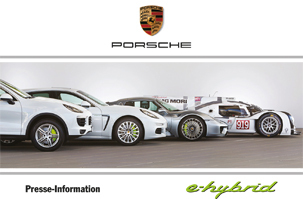
Also encompassed by this extensive pool of knowledge is the high technology of the Porsche 911 Hybrid, the LMP1-class racing car, with which Porsche participates in the World Endurance Championship (WEC). It is a mobile research lab for the ongoing development of hybrid technology, aiming at achieving top vehicle dynamics and efficiency. It makes available extensive findings gained from what are probably the most extreme conditions in motorsport, which can also be incorporated into production vehicles – in fact, just as the standard practice at Porsche has always been.
More articles of Plug-in hybrid technology
from Porsche