 ";
";
Porsche · digital presskit
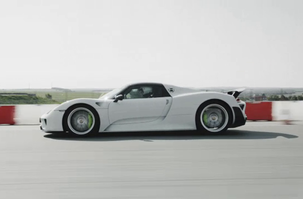
With the 918 Spyder, Porsche has launched into the future of the sports car. In addition to top performance on the racetrack, it is able to glide through the city with zero emissions and in almost total silence. Maximum performance from 887 hp of system power and fuel consumption of 3.1 litres per 100 kilometres (NEDC) are the result of its unique plug-in hybrid concept.
The 918 Spyder is the first production car to feature three motors independent of each other, which can be individually controlled and at the same time enable a unique all-wheel drive concept. They thus fully exploit every possibility that the combined drive system provides. Via a 'mapping switch' on the steering wheel the driver is able to choose between five driving modes, which optimally control the sole or mixed drive system. The spectrum ranges from all-electric driving all the way to an uncompromising set-up for the racetrack. The 918 Spyder is thus a vehicle with competitive racing credentials and at the same time an uncomplicated everyday sports car.
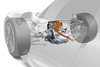
The 4.6-litre eight-cylinder engine delivering 608 hp and the rear electric motor with an output of 115 kW (156 hp) are arranged in line on a common shaft and drive the rear axle via the Porsche Doppelkupplung (PDK). With an output of 95 kW (129 hp), the second electric motor sends its power via a single-stage gearbox and a disengagement clutch to the front wheels. Optimum coordination of the three power sources is one of Porsche's core competencies and ensures the 918 Spyder's outstanding performance: thanks to the additional, individually controllable front-wheel drive in the 918 Spyder, it is possible to implement new driving strategies for extremely high and safe cornering speeds.
The overall concept results in a crankshaft-equivalent maximum torque of 1,280 Nm in seventh gear. The term 'crankshaft equivalent' expresses the amount of torque that the engine of a conventional drive system would have to produce in order to develop the same drive-wheel traction. The characteristics of the high-rev naturally aspirated engine with immense torque at higher engine speeds and the electric motors with powerful torque right from a standstill complement each other ideally: within a broad rpm range of 800 to 5,000 revolutions per minute, the torque plateau always remains above 800 Nm.
For the driver the drive system concept means almost limitless power from the very first revolution and associated with that fast starts, a strong pull-away and impressive acceleration. In addition it provides enormous driving fun whenever by pressing on the accelerator the high-torque electric motors give an extra boost to the V8 high-rev engine and release the unrestricted full power and a catapult-like capacity for acceleration. In 2.6 seconds the car reaches 100 km/h; in 7.3 seconds it's at 200 km/h.
The hybrid module deploying its power to the rear axle is connected directly to the V8 engine. It consists in the main of the electric motor and a dry disengagement clutch as the connecting element to the internal combustion engine. Acting as a parallel hybrid module, it powers the 918 Spyder both individually via the internal combustion engine or electric motor and combined via both drive systems as well. Typically for a super sports car from Porsche, the power pack sits in front of the rear axle and has no direct mechanical connection to the front axle.
The transmission of power is handled by a seven-speed dual-clutch gearbox optimised for high-performance use. Compared to the other Porsche model ranges, it is turned over 180 degrees about the longitudinal axis in order to ensure the lowest possible installation position and thus centre of gravity for the entire vehicle. Whenever no drive power to the rear axle is required, the two drive systems can be disconnected by opening the disengagement clutch and PDK clutches. This facilitates typical Porsche 'coasting' up to a speed of 150 km/h with internal combustion engine switched off.
More articles of Porsche 918 Spyder