Porsche · digital presskit
Plant expansion from autumn 2011 to late 2013
The Porsche plant in Leipzig – details of the environmentally-friendly factory
The decision to produce the future Macan in Leipzig and therefore to expand it into a fully capable factory was made in 2011. From then on, everything happened in quick succession. In October of the same year, the foundations were laid for the plant expansion.
At that time, the stated goal was to start production at the end of 2013. This ambitious goal was clearly reached. In particular, the short amount of time required for the many approvals to be issued by regulatory authorities speaks highly of Germany’s potential as a place to do business and of the results oriented performance of the Porsche project team responsible.
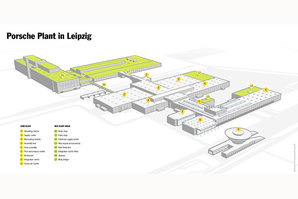
New body shop supply centre. The aluminium and steel sheet metal body parts – currently for the Macan – are produced at various press works by 40 suppliers, both internal to the Group and external, and are delivered to Leipzig at specific cycles. In the new body shop supply centre, which has a floor area of around 10,000 square metres, the parts are then electronically logged-in and transported to the body shop by tugger trains. The Porsche logistics concept enables fast turnover of pressed goods; no conventional warehousing is needed.
New body shop. In June 2012, Porsche celebrated the topping-out ceremony for the body shop; just three months later, the first systems were installed in this area. Thanks to a highly professional team of Porsche planning specialists, experts and architects, as well as the company’s close and cooperative working relationships with responsible standardization organizations and government authorities of the German state of Saxony and the city of Leipzig, Macan pilot series car no. 1 was produced for internal status quo evaluation just 16 months after excavating for the first foundations. Over a production area of 35,000 square metres, 387 industrial robots are used to build the new Macan bodies in mixed aluminium-steel construction and at the usual high level of Porsche quality. The steel and aluminium stamped body parts that are delivered via the Porsche production system are joined together in Leipzig with around 6,000 welds.
Electrical consumption reduced by solar power. The energy efficiency of the new facility was optimised by installing a photovoltaic system on the roof. It was designed to generate up to 800,000 kWh of electricity annually via solar power. In parallel, Porsche always saves energy wherever possible. In body manufacturing, for example, a newly designed cooling system for robot welding rods reduces annual electrical consumption by over 365,000 kWh; that is equivalent to the annual electrical consumption of over 70 four-person households in Western Europe.
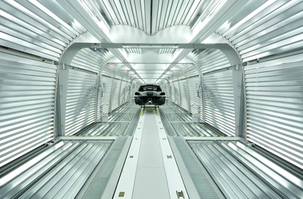
New paint shop. The new paint shop was built almost simultaneously with the body shop. The time window for implementing the 360 metres long, 72 metres wide and 30 meters tall new building qualifies was relatively narrow. After excavation work in October 2011 and structural construction that began in March 2012 had been completed, the topping-out ceremony for the building complex with 60,000 square metres of floor area was held in November of the same year. Here too, the classic comparison with the size of a football field (standard FIFA football field) illustrates the enormous dimensions of the shop: its 60,000 square metres is equivalent to the area of around eight professional football fields. The first painting robots were started up back in the summer of 2013 – less than one and a half years after construction of the building had begun. A total of 81 robots paint the vehicles in eleven different colours and a wide variety of custom colours.
Clean air and heat from biomass power plant. A newly developed separation system ensures that the emissions in the paint fog are reduced to a minimum. At the same time, 2.3 million cubic metres of air is moved per hour – as supply air, exhaust air and recirculation air. The exhaust air is cleaned in a wet chemical process. The paint shop sources the energy that is input into its operation innovatively. Here, Porsche uses a biomass power plant located next to the factory; this sustainable alliance covers 80 per cent of the paint shop’s heat needs CO2-neutrally. The results: CO2 emissions have been reduced by over 8,000 metric tonnes annually.
Extended supply centre for assembly. Supplying an entire automotive plant with parts is a logistical master achievement. To supply these parts to the assembly lines with cyclic precision – without an intermediate warehouse – deserves even more respect. That is precisely how it is done in Leipzig. Because the Macan is now also assembled here, Porsche doubled the floor area of the existing “assembly supply centre” (not to be confused with the new “body shop supply centre”) – from 20,000 to 38,000 square metres. Around 4,500 different parts make their way into the assembly hall from here.
New assembly line. Production of the successful Cayenne and Panamera models has been running at a fast pace for many years now. By the end of December 2013, around 700,000 units of these two model series were produced in Leipzig. All the more noteworthy is the fact that in parallel to the ongoing production activities the new production line for the Macan was integrated into the extensively enlarged assembly hall. Production experts have compared the extremely challenging timing of this process to open heart surgery on the plant. The operation was successful. Since the start of Macan production, three Porsche model series are now being assembled in parallel in Leipzig by a highly flexible method known as mixed production. In three shifts, employees on the production lines not only assemble Porsche cars with petrol and diesel drive systems, but also hybrid vehicles (currently the Cayenne) and plug-in hybrid models (currently the Panamera).
Picking up a new car at the Customer Centre. In just 2013, over 2,300 of these new Porsche cars were picked up by their owners at the customer centre in Leipzig. One special aspect of picking up a car at the plant is a test drive over the 3.7 km long race track (FIA certified) – where customers are provided with vehicles of the same type as their new car. If the vehicle is a Cayenne, a test drive on the 6.0 km long off-road course is also included. An instructor shares information with customers about their new cars and about the vehicle run-in track and test track. All Panamera and Cayenne cars delivered from Porsche centres – up to 500 daily – leave the plant via railway and lorry for delivery to over 120 countries worldwide. There will be even more cars now with the addition of the Macan.
More articles of Short and
snappy
Milestones
- Plant opening for the first generation Cayenne in August 2002
- Production of the Panamera launched in April 2009
Video
Trailer Porsche Plant in Leipzig