
Porsche · digital presskit
The evolution of the 911 design
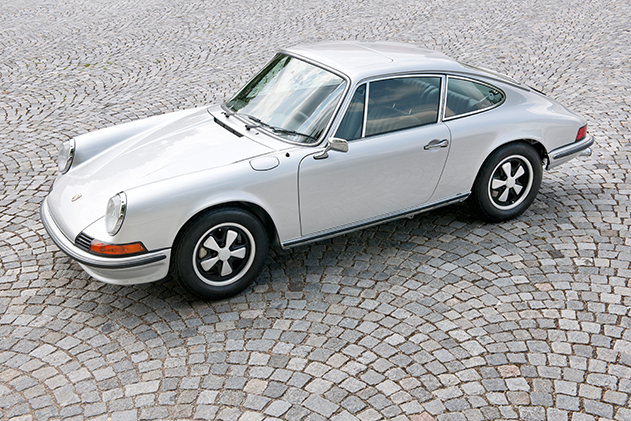
After the historic original design of the 911 by F.A. Porsche, every designer in the history of the brand has been faced with the enormous challenge of retaining the iconographic elements of the 911, while simultaneously translating it into the future with a contemporary use of form. This has been successfully achieved with every model generation – the 911 is still a totally unmistakeable sports car.
The first 911 defined the basic form that has been retained into the present. For example the lateral contours, the design of the fastback, the shape of the side windows, the separate front wings with the flat bonnet between them – these are some of the key characteristics of its design.The G model in the year 1973 was the next significant step after the original model. The design of its bumpers caught the eye immediately. They are painted in the same colour as the car, have rubber moulding all the way along, as well as integrated front indicator lights and plastic bellows at the side. These were introduced due to new laws in the USA that decreed that no vehicle repair costs were to be incurred at an impact speed of less than 5 km/h. As a result, Porsche produced the bumpers from robust light alloy; on cars for the USA they were affixed flexibly to the frame by means of replaceable impact tubes as well as a hidden spring construction. On the Carrera, the exterior mirrors and the headlight moulding, which had previously been chrome-plated, were also painted in the same colour as the car. Between the two rear lights was a dark red panel with the Porsche name in black lettering. The 911 Turbo, part of the G model range, drove the design forward. Its large rear spoiler with flexible polyurethane frame is a very distinctive feature. Together with the wing flares, and the exterior mirrors and headlight mouldings painted in the same colour as the car, the rear spoiler gave the Turbo its own totally unique appearance. This Turbo look was later available for other 911 types and for some model years also without the large rear wing. On request, the Turbo could be ordered from 1982 onwards as a low profile version as well. Low profile cars had already been used by Porsche in motor races, whereby pop-up headlights facilitated a low bonnet. In 1982, the forward-looking 911 SC Cabriolet was also introduced. The innovative hood was designed as a bow construction, 50% of which was made of pressed sheet steel sections. This ensured dimensional stability even at high speeds as well as protection in the event of a crash.
The 964 series was introduced in model year 1989. The design of its body was extremely similar to that of the 911 but had been completely redrawn. Two of its main features were that the front and rear end were now integrated into the body shape and the rear spoiler automatically moved into raised position on the Carrera 2 and Carrera 4 models. The slipstream underbody panelling was not obvious at first glance but was nevertheless of great functional significance. The Turbo was given the new body two years later.
In 1993, the 993 model generation was introduced. In comparison to the previous 911, it had reworked front and rear ends. New features were the headlights that protruded somewhat lower and a wider, flatter rear. The rear side windows were now bonded flush with the body. The Cabriolet hood had been completely reworked – the rear section was flatter, giving the Cabriolet a sportier look when the hood was closed. The Targa was presented at the IAA in 1995. Also, small details on the body of the 911 Turbo were modified, for example a redesigned front and rear end and a sill design that harmoniously joined the flared wings. The fixed rear spoiler was also redesigned.
More articles of The Design
- The design
- The evolution of the 911 design
- 1997: Reworked body design with improved drag coefficient
- 2011: The 911 design enters a new era