
Porsche · digital presskit
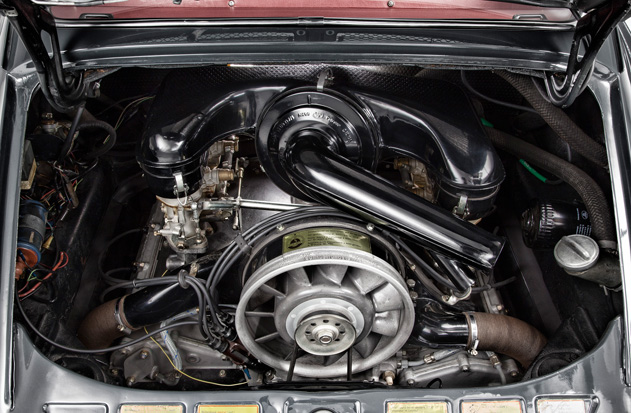
1965, 911 2.0 litre-engine
In coming up with the conceptual design for a new engine in the 356 successor, it was clear from the outset that it would be a rear engine. Under the leadership of the nephew of Ferry Porsche, Ferdinand Piëch, an air-cooled six-cylinder flat engine was created with an axial blower and – due to its higher rev reserves and more refined running properties – one overhead camshaft per side. The camshafts were chain driven after bevel shafts or toothed belts were retired. The initial specification called for 2 litres of displacement with a potential for increases up to 2.7 litres. At that time, none of the Porsche technical specialists could have foreseen that this engine type, in its basic form, would be continued up to the year 1998 or that its displacement would reach 3.8 litres.
The flat engine was air-cooled up to and including the type 993. Then engineers switched over to water cooling – one benefit was that this let them move into new performance classes. At first, this shift met with scepticism by many enthusiasts, and for some purists it still represents a break with 911 history. But in the view of automotive experts, the shift to water cooling did not by any means water down the total 911 package, rather just the opposite was the case. Its importance has increased in every model series ever since it was introduced. The six-cylinder flat engine of the type 901/911 generated a power of 96 kW (130 hp) at 6,100/min from 2 litres displacement. For the sake of completeness, a brief mention should also be made of the Porsche 912 here. It was launched in parallel with the 911 in spring 1965; it was a lower power version and had the four-cylinder engine of the type 356 with a displacement of 1.6 litres and 66 kW (90 hp) of power. It was fitted with simpler features than in the 911. The 912 was produced in the Coupé and Targa body forms until summer 1969.
Starting in model year 1967, the power-boosted 911 S version produced 118 kW (160 hp) at 6,600/min – and the “normal” 911 soon carried the model identifier 911 L, and later 911 E. Engineers were especially proud of having achieved this power boost in the 911 S and a power-to-displacement ratio of 80 hp per litre without any reduction in engine life. Starting in 1967, there was also the 911 T with reduced power output (81 kW/110 hp at 5800/min), which was designed as an entry-level model.
The first vehicles to feature engines with an emissions control system were offered in the USA in 1968. Porsche succeeded in fulfilling emission regulations in the USA – including especially strict rules in California – without compromising car performance and with nearly identical ride comfort. Emissions were controlled by exhaust gas recirculation in the induction manifold and by thermal reactors. Porsche was the first company in Europe to install emission test benches for its development work.
In autumn 1968, Porsche introduced mechanical petrol injection. There were new engines for the 911 E and the 911 S – the first produced 103 kW (140 hp) at 6500/min, while the second produced 125 kW (170 hp). Both engines were designed with an eye towards further power increases. From the outset, their emissions behaviour was developed to meet the strictest regulations. The six-cylinder flat engines had sodium-filled exhaust valves – this technology from motorsports guaranteed that the engines could handle sustained full throttle operation.
More engine displacement resulted in more power and torque; it was first increased to 2.2 litres in 1969, then to 2.4 litres two years later. In the 911 S, for example, this initially boosted power to 132 kW (180 hp) and then to 140 kW (190 hp). In 1971, to satisfy increasingly more stringent emissions regulations, the engine’s compression ratio was also reduced so that all 911 cars could continue to be driven with regular petrol worldwide. In 1972, the K-Jetronic made its debut, initially for the USA. A new six-cylinder model debuted in the same year: the Carrera RS with a 2.7-litre engine, 154 kW (210 hp) at 6300/min and a torque of 255 Newton metres; it had a very low unladen weight of 1075 kg with standard equipment. In 1973, all engines were switched over to 2.7 litres displacement in the G model; at the same time, the use of regular unleaded petrol was enabled – Porsche was proving that sports cars could be eco-friendly as well. In 1974, 111 units of the Carrera RS were built with 3-litre engines as homologation vehicles for Group 3.