
Porsche · digital presskit
1997: The first water-cooled Porsche six-cylinder engine
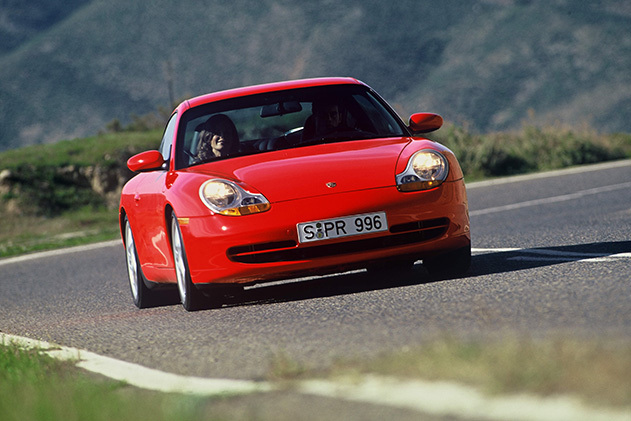
In 1997, the 996 model series made a quantum leap in 911 history. It not only got a completely new body, but also a water-cooled flat engine.
The engine, with its 3.4 litres displacement, was significantly shorter (by 70 mm) and much lower (by 120 mm) than the previous engine. It produced 221 kW (300 hp) at 6800/min and was much better at high revving than the previous naturally-aspirated engine. However, its key design properties were unaltered: six-cylinder, seven-bearing crankshaft, dry sump lubrication, dual-mass flywheel and a longitudinally split engine housing. Only available in the 911 Carrera at first, one year later the new engine was also offered in the Carrera 4, and the Turbo was also switched over to water cooling. Then there was the GT3, whose naturally-aspirated engine was based on that of the GT1 but developed 265 kW (360 hp) at 7200/min. In 2000, the Turbo received a new engine (309 kW/420 hp at 6000/min, 560 Newton metres) that was derived directly from the GT1. It simultaneously served as the basis for the new GT2 (340 kW/442 hp at 5700/min, 620 Newton metres).Displacement was increased for the naturally-aspirated engines in 2001, it was now 3.6 litres in size. That was sufficient for a power boost to 235 kW (320 hp) at 6800/min and a torque of 370 Newton metres. The improved biturbo engine in the GT2 now produced 355 kW (483 hp). The GT3 RS, which launched in 2003 and was primarily intended for motorsports, had a higher power output of 280 kW (381 hp) that was primarily due to its higher revving capabilities and an adjustable camshaft.
The next generation 911 of the 997 model series appeared in 2004. The 3.6-litre naturally-aspirated engine of the Carrera was preserved, while the Carrera S was distinguished by a new engine. From 3.8 litres displacement, it produced 261 kW (355 hp) at 6600/min and developed a torque of 400 Newton metres. The next GT3 (305 kW/415 hp) was also based on the 997 model series; it was presented at the Geneva International Motor Show in March 2006. One year later, the next GT2 appeared, whose biturbo engine produced 390 kW (530 hp) at 6500/min. In 2008, the 911 and 911 S models then received fundamentally new engines with direct petrol injection. At the same engine displacements, they produced 254 kW (345 hp) at 6800/min and 283 kW (385 hp) at 6500/min, respectively. Using direct petrol injection, combustion can be controlled more precisely according to specific operating states, which has resulted in significant fuel savings.
“Downsizing” for improved fuel efficiency became a guiding design principle for engine engineers starting around 2008. Exploiting its bundled knowledge, Porsche developed new downsizing technology for the 911 of the 991 model series, which appeared in 2011: For example, the flat engine in the 911 Carrera (257 kW/350 hp at 7400/min, 390 Newton metres) was given a displacement of 3.4 litres instead of the previous 3.6 litres. The Carrera S (294 kW/400 hp at 7400/min, 440 Newton metres) retained its 3.8 litres of displacement. Both of these vehicles illustrate how the 991 model series has been reengineered for maximum fuel efficiency in a total package. With a weight-to-power ratio of 3.5 kg per hp, the new 911 Carrera S is at the top of its competitive field. And in terms of NEDC fuel consumption, the 911 Carrera with 8.2 litres per 100 km and the 911 Carrera S (with 8.7 litres) – each with Porsche Doppelkupplung – once again exhibit top values. At the same time, they are the latest statements by Porsche that it is always the engine that is the heart of a sports car – that power and efficiency are not mutually exclusive and have never been in the 50 years of 911 history at Porsche.
More articles of The Flat Engine
- The flat-six engine
- 1974: Beginning of the 911 Turbo era
- 1997: The first water-cooled Porsche six-cylinder engine