
Porsche · digital presskit
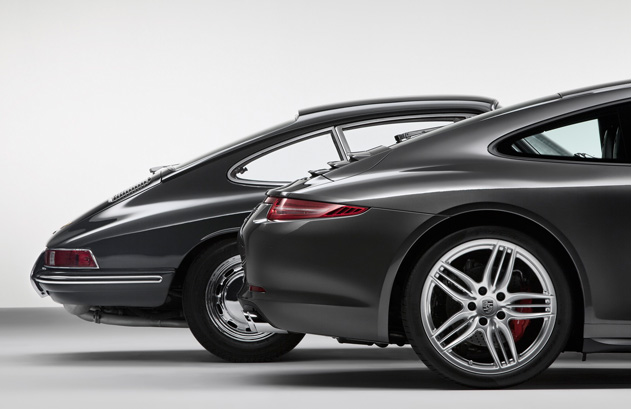
An important aspect of the 911 legend is without doubt the timeless design of the series. A Porsche 911 is immediately recognisable from every perspective and can be identified without the Porsche crest or nameplate. However, at Porsche there was a great deal of uncertainty about the design of the future successor to the 356 during the early development phase.
Only after several internal and external studies did Ferry Porsche’s son Ferdinand Alexander complete his historic design. F.A. Porsche, as he was called by his colleagues, joined the design office of what was then Dr. Ing. h.c. F. Porsche KG in 1958. He was soon able to prove his vast creative talent when, in 1959, he sculpted a pioneering model of a successor to the 356 series out of plasticine. In 1960, the 754 “T7” prototype was created on the basis of his designs. It was an extremely promising study of a four-seater car, however its rear end did not yet meet with Ferry Porsche’s approval. He decided against developing the four-seater “T7” in favour of the “T8”, a fastback coupé with 2+2 seating arrangement that was developed from 1962 onwards under the project name “Type 901”.The design was an enormous success for F.A. Porsche, who was 27 years old at the time. The emotional but at the same time functional shape joined together automotive and product design, which were still kept strictly separate in the design world at the beginning of the 1960s. In the original 911, F.A. Porsche distilled the Porsche design DNA into a concentrated masterpiece. He created an unmistakeable brand design which still gives all Porsche series their identity today and is the basis for their success. The archetypal shape has the effect of an organic sculpture which allows the car to be immediately identified as a 911 from every angle, even without the Porsche nameplate. And the Porsche designers have never succumbed to the temptation to follow fashionable trends with any of the now seven 911 generations. Instead, the design has been enhanced by means of a careful evolutionary process and has always kept its own identity. And it goes without saying that the design has always borne functionality in mind. Stylistic gimmickry has never been a part of the Porsche 911. And it has adhered to this principle for five decades. Its design has always been modern but never trendy – as should be the case with a genuine classic car. Today, it therefore still remains true to the credo of its creator F.A. Porsche whose motto was “Good design has to be honest.”
The design of the 911 also always reflects the work of the head designer at the time. After F.A. Porsche, who founded his own company “Porsche Design Studio” in 1972, Anatole Carl Lapine became the sports car manufacturer’s head designer, a position he held until 1989. He was followed by Harm Lagaay. Michael Mauer took up the post in the year 2004 – and with the current 991 series he has created his own masterpiece within the 50-year history of the 911.