
Porsche · digital presskit
1997: Reworked body design with improved drag coefficient
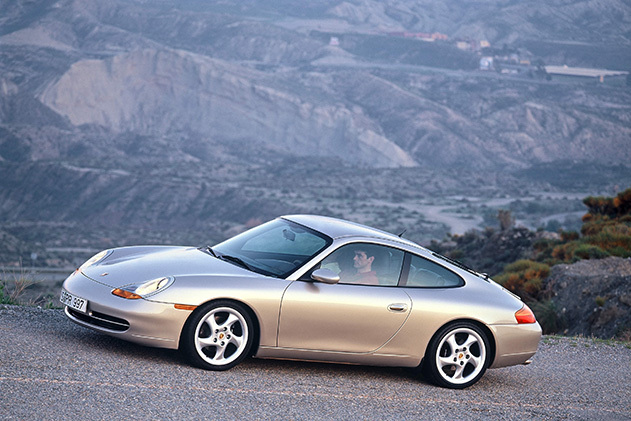
The 996 series in 1997 not only introduced water-cooled engines to the 911 but also a new body design. The roof line with a windscreen which is around five degrees flatter gives the side view a more fluid look. Furthermore, the entire main body was made sleeker, for example by means of smaller gaps and windows that were fully flush with the body.
All the measures put together also have a functional effect, producing a drag coefficient of 0.30 – the coefficient of the 993 was 0.34. The two exterior mirrors are no longer affixed to the door but are mounted onto the side window triangle. The Cabriolet was delivered as standard with a light alloy hardtop painted in the same colour as the car. It weighed only 33 kilogrammes and two people could easily remove and install it. The body of the 2001 model year 911 Turbo was extensively redesigned. The most important features which distinguished it from the Carrera models were different front and rear end trims and a rear spoiler with moving wings and air intake ducts to the air coolers. The front wings were widened and bi-xenon headlights could be integrated. The extendable rear wing of the Turbo was a completely new development. At high speeds it had a significant impact on the aerodynamics of the vehicle and thus, above all, on driving stability. The rear spoiler comprised two wings, one on top of the other. Up to a speed of 120 km/h, the wings were on top of each other; at speeds in excess of this the hydraulics raised the top wing by 65 millimetres. If the speed of the car fell below 60 km/h, the wing was lowered into the base spoiler once again. For model year 2002, the 996 series was given new headlights and therefore a slightly redesigned front, including the front wings.A completely new 911 generation had its debut in 2004 in the form of the 997 series. One of its main features was its oval headlights. From a distance they looked virtually circular – this element thus bringing the new 911 closer to the original 911 again. In addition to the headlights, other lights such as the parking lights, fog lights and indicators were integrated into the unit behind a clear plastic disc, which gave the entire front of the vehicle a clearly structured and extremely uncluttered appearance. The wind tunnel was an important tool for designing the 997 series and all the aerodynamics measures ensured that, with a value of 0.28, it boasted the lowest drag coefficient of any Porsche series production vehicle to date.
More articles of The Design
- The design
- The evolution of the 911 design
- 1997: Reworked body design with improved drag coefficient
- 2011: The 911 design enters a new era