
Porsche · digital presskit
1974: Beginning of the 911 Turbo era
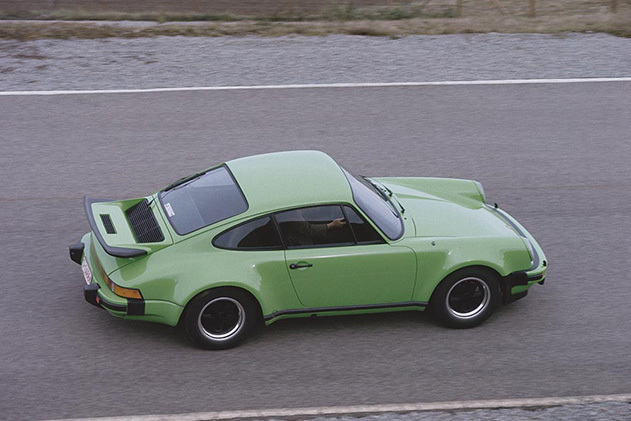
Another legend made its debut in 1974 as well: Porsche introduced the 911 Turbo, the first production sports car with a turbocharger.
The manufacturer had transferred its extensive experience with charged engines from motorsports to series production. The engine was based on the engine of the 911 Carrera RS 3.0, it produced 191 kW (260 hp) and a torque of 343 Newton metres and accelerated the car to a top speed of over 250 km/h.In the year 1976, continually more stringent emissions regulations had to be satisfied, especially in the USA, Canada and Japan. Initially, vehicles for these markets received complex emissions control systems. Meanwhile, the types 924 and 928 appeared, and in 1977 the company reduced its 911 line-up to the 911 SC (3 litres displacement, 132 kW/180 hp) and 911 Turbo models. The Turbo got an engine with a higher 3.3 litres displacement that was also equipped with an intercooler. The results: a solid 221 kW (300 hp) at 5500/min and a torque of 412 Newton metres.
Porsche built the first engines with regulated catalytic converters in 1980. Over the course of their design revisions, they received an oxygen sensor whose signals were processed in a controller and were used directly for mixture control. In 1979, the power of the 911 SC was also boosted to 138 kW (188 hp), then one year later to 150 kW (204 hp) at 5900/min.
A new generation of naturally-aspirated engines was presented in 1983 with 3.2 litres of displacement and digital engine electronics. All engines were now prepared for unleaded regular petrol – this fuel was still unavailable in many European countries, so this modification would permit a flexible reaction to its availability. In the 911 Carrera, the engine produced 170 kW (231 hp) at 5900/min and delivered a torque of 284 Newton metres (for USA and Japan: 152 kW/207 hp and 260 Newton metres). There was one disappointment, however: Customers in the USA had to do without the 911 Turbo for several years, because its engine was not configured for the use of a catalytic converter. It would return in 1985 with 210 kW (282 hp) of power.
The Carrera 4 made its debut in 1988 and received a new engine with 3.6 litres displacement; it produced 184 kW (250 hp) at 4800/min and offered a torque of 310 Newton metres. One unique aspect was that it featured two spark plugs per combustion chamber to assure better combustion. The Carrera 2 introduced one year later – which replaced the previous 911 with rear-wheel drive and a naturally-aspirated engine – also got this engine.
The year 1990 saw a new edition of the 911 Turbo with a new engine. Its features included thermally optimised cylinders and cylinder head seals made of stainless steel. The engine now developed 235 kW (320 hp) at 5750/min and a torque of 450 Newton metres from the same 3.3 litres of displacement. One year later, a fine delicacy for motorsport oriented customers made its appearance: the 911 Carrera RS, whose 3.6-litre engine was power-boosted to 191 kW (260 hp). Its actual highlight was a low gross weight of 1120 kg (with manual gearbox) compared to the 1350 kg of a Carrera 2. Since the RS could not be registered in the USA, the RS America was sold in this market which featured engine technology of the Carrera 2 plus sport chassis and a rear spoiler. In 1992, the Turbo S was introduced – of which only 86 units were produced; its engine developed 280 kW (381 hp) at 6000/min and a torque of 490 Newton metres. Its successor followed in 1992: the 911 Turbo 3.6 with 265 kW (360 hp) whose higher power – compared to that of an equivalent naturally-aspirated engine – was primarily obtained from higher charge pressure and a modified ignition map. Its torque was 520 Newton metres.
In 1993, various modifications were made to the Carrera engine in the just introduced 993 model series to boost its power to 200 kW (272 hp) while retaining the same engine displacement and compression ratio. These modifications included a torsionally stiffer crankshaft, improved and lighter connecting rods, lighter and further improved pistons and a die-cast aluminium engine block with nickel-silicon coated running surfaces. For motorsport, a short production run of the 911 GT2 was made; with two turbochargers its 3.6-litre engine could develop 316 kW (450 hp) at 5750/min (street version: 316 kW/430 hp). The Turbo also adopted the biturbo concept, and another global innovation was the OBD II emissions system monitoring. Now producing 300 kW (408 hp) of power, the engine was indeed based on the 3.6-litre naturally-aspirated engine, but it was so extensively modified that it was essentially a new design. Its features included a different camshaft, reinforced connecting rods, pressed and coated pistons, pressed alloy cylinders with surface coating and lengthened intake ports.
More articles of The Flat Engine
- The flat-six engine
- 1974: Beginning of the 911 Turbo era
- 1997: The first water-cooled Porsche six-cylinder engine