
Porsche · digital presskit
1977: Charge air cooling
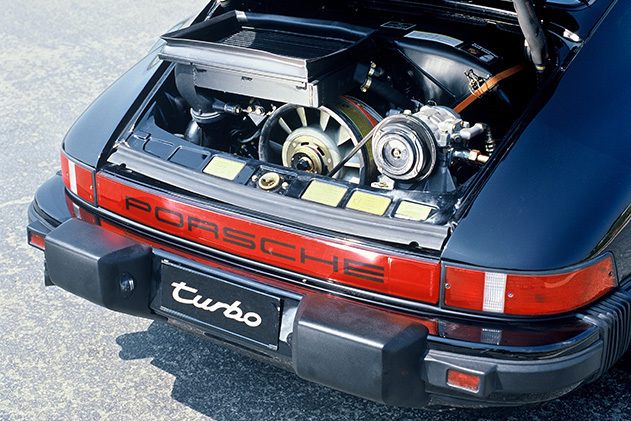
One of the secrets of the success of the 911 series is that it has been enhanced constantly and systematically. Each year, lots of small details on the 911 have been improved so that it has become closer and closer to Ferry Porsche’s ideal image of a perfect sports car. This philosophy was also applied to the 911 Turbo. The main features of the 911 Turbo, reworked in 1977, were an increased displacement of 3.3 litres and a charge air cooler positioned underneath the rear spoiler. Derived from the field of motor racing, it was a world first in a series production car. The charge air cooler reduces the intake air temperature by up to 100 degrees Celsius, thus enabling the engine to achieve higher output and torque in all engine speed ranges – cooler gases are denser and therefore charge the engine more effectively. The result was a stable 300 hp at 5,500 rpm and a maximum torque of 412 Newton metres. Furthermore, the charge air cooling also reduces the thermal load on the engine. The exhaust gas temperatures fall, as do the emissions, and fuel consumption is reduced. Another advantage is the improvement in antiknock properties – excess temperatures causing the mixture to self-ignite is virtually ruled out.
More articles of The Innovations
- The innovations
- 1963: Three-part safety steering system
- 1965: Targa roll-over protection bar
- 1966: Internally ventilated disc brakes
- 1972: Front and rear spoilers
- 1973: Turbocharging
- 1975: Galvanised body
- 1977: Charge air cooling
- 1983: Digital engine electronics
- 1988: All-wheel drive
- 1989: Tiptronic
- 1993: LSA aluminium chassis
- 1995: Bi-turbocharging
- 1995: OBD II emissions control system
- 2001: Ceramic brake disc
- 2008: Porsche Doppelkupplung PDK S
- 2011: Intelligent aluminium-steel design
- 2011: Seven-speed manual gearbox