
Porsche · digital presskit
2001: Ceramic brake disc
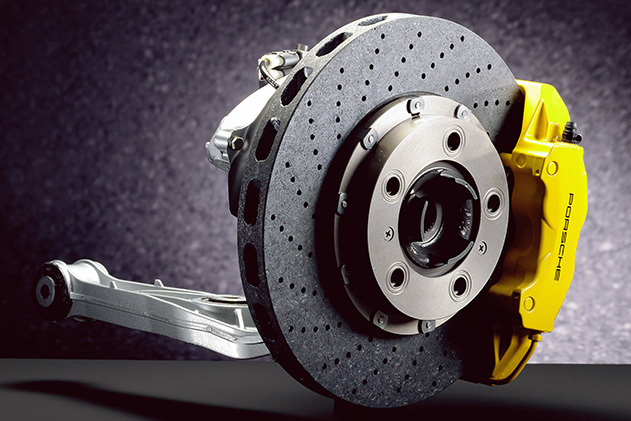
In the year 2000, Porsche introduced the 996 series 911 Turbo. It could be fitted with ceramic composite brake discs as an option. They came as standard on the 911 GT2. The new brakes, called the Porsche Ceramic Composite Brake (PCCB), were an important technological advance and set new standards, particularly with decisive criteria such as response, fading stability, weight and service life. Porsche was the first automotive manufacturer in the world to successfully develop a ceramic composite brake disc with involute cooling duct for efficient internal cooling. The ceramic composite brake discs were perforated, just like metal brake discs. However they weighed more than 50 per cent less. One the one hand, this lowered the weight of the vehicle by 20 kilogrammes, thus saving fuel. On the other hand the unsprung masses were also reduced which further improved the response characteristics of the shock absorbers. Ceramic brake discs also have other advantages. Their friction coefficient always remains constant and an emergency stop with PCCB does not require the brake pedal to be actuated with force nor any technical assistant systems which help to generate the maximum brake force in a fraction of a second. The PCCB provides maximum braking immediately and without pressure on the brake pedal. It also boasts excellent response characteristics in wet conditions as the newly-developed brake pads collect less water in comparison with conventional pads. The ceramic brake disc can easily cope with high brake loads that often arise with a sporty driving style in particular.
More articles of The Innovations
- The innovations
- 1963: Three-part safety steering system
- 1965: Targa roll-over protection bar
- 1966: Internally ventilated disc brakes
- 1972: Front and rear spoilers
- 1973: Turbocharging
- 1975: Galvanised body
- 1977: Charge air cooling
- 1983: Digital engine electronics
- 1988: All-wheel drive
- 1989: Tiptronic
- 1993: LSA aluminium chassis
- 1995: Bi-turbocharging
- 1995: OBD II emissions control system
- 2001: Ceramic brake disc
- 2008: Porsche Doppelkupplung PDK S
- 2011: Intelligent aluminium-steel design
- 2011: Seven-speed manual gearbox