Porsche · digital presskit
Overview – a systematic approach to production
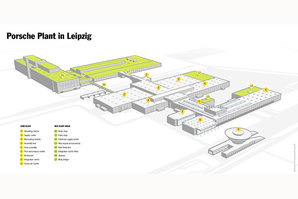
Leipzig assembly plant becomes a comprehensive factory
- Porsche produces the Macan, Cayenne and Panamera in Leipzig
- Porsche launches second comprehensive factory in Leipzig with body shop and paint shop
- Porsche plant in Leipzig specialises in models with front-mounted engines
Three production sites. Porsche builds four sports cars, one sport saloon and two sport SUVs. The latest model series of its product range is the Macan. The various model series are conceptually subdivided into two groups: the Porsche cars with rear or mid-engines (sports cars) and the Porsche cars with front engines (sport saloon and SUV). The range of sports cars comprises the Boxster / Cayman model series (flat-six cylinder mid-engines), the 911 (flat-six cylinder rear engines) and the 918 Spyder (V8 mid-engine plus electric motors). One of the world’s sportiest sedans is the Panamera (V6 and V8 engines; as hybrid plus electric motor). In the SUV (Sport Utility Vehicle) class, the new Macan (V6 front engines) complements the larger Cayenne (V6 and V8 front engines; as hybrid plus electric motor). All Porsche cars are manufactured in Germany – distributed to three production sites based on drive system concept:
• Stuttgart-Zuffenhausen:
The Boxster, 911 and 918 Spyder are produced here – Porsche cars with a rear or mid-engine.
• Osnabrück:
The Cayman and Boxster are produced here – Porsche cars with a mid-engine.
• Leipzig:
The Macan, Cayenne and Panamera are produced here – Porsche cars with a front engine.
Porsche production system. At all three production sites, production and logistics processes are oriented towards the Porsche production system that is considered path-breaking. It guarantees that a new Porsche can be optimally produced with top quality as well as with a large measure of handcrafted individuality in the variety of features it offers. The Porsche production system is subdivided into four modules:
• Product engineering – every Porsche is engineered for production and for quality.
• Process engineering – systematic implementation of processes for new products.
• Process optimisation – continuous optimisation of production processes and products by the Porsche improvement process, also known as PVP.
• Process assurance at suppliers – Porsche consistently integrates its partners into the value creation chain.
The Porsche production system was developed in the 1990s and is based on four principles of “lean production”. It is still based on these principles today:
• Flow principle – all value creating processes are networked with one another by highly innovative logistics. The production steps and materials they require generate the flow of value creating activities.
• Cycle principle – manufacturing at the “customer cycle”. Here, Porsche buyers as customers establish a certain cycle that results in production volumes. At the same time, internal employees are also viewed as “customers” who are involved in the specific cycles of production. “This cycle is the driver for all production and logistics processes during the production of a Porsche.
• Pull principle – the internal “customers”, i.e. the employees in the body shop, paint shop and assembly – cyclically “pull” materials from the logistics supply centres. In turn, logistics only issues production releases to suppliers for the quantities of vehicle parts needed to meet the momentary supply demands of production. This is done to avoid over-production and unnecessarily large buffers. That is, vehicle parts are only provided via the supply centres at the plant when there is a need for them.
• Zero errors principle – assurance of stable processes and error-free products (“do not accept any errors, do not make any errors, do not pass on any errors”).
Challenges for the Porsche production system. These building blocks of the production system are implemented and validated by projects and workshops developed specifically for them. The goals here include continually reviewing processes and boosting efficiency. The challenges encountered by Porsche with this production system are especially difficult, because one vehicle is hardly like another. The reason is that Porsche as a premium carmaker offers a degree of customisation that otherwise can only be achieved in handcrafted car manufacturing. This complexity is escalated by the fact that three model series – with their many different versions – are to some extent produced on one and the same production line in Leipzig. Nonetheless, Porsche is solving these challenges with a perfectly conceptualised logistics process chain. This type of production is based on the string of pearls principle. It achieves very stable information and material flows. At Porsche, this means that the production sequence for vehicles is already firmly established seven days before the vehicle parts arrive in the assembly area.
A Porsche is designed for production. A universal approach like that of the Porsche production system, in which production parameters merge with the engineering of the vehicle, is by no means the standard industry practice. This aspect is already established early in the design phase of a Porsche. Dr. Oliver Blume, Porsche Board Member for Production and Logistics comments: “The Porsche production system not only addresses how the production system is structured, rather we begin to conceptualise a Porsche that is optimally designed for production at a very early phase of vehicle development.” It is easy to see why there are large production synergies among rear and mid-engine sports cars related to their similar construction, and such synergies also exist among all front engine models. The centrally controlled Porsche production system is therefore a decisive factor in enabling joint production of the sports cars in Stuttgart and Osnabrück and producing the new Macan together with the Cayenne and Panamera in Leipzig.
More articles of Overview
Milestones
- Plant opening for the first generation Cayenne in August 2002
- Production of the Panamera launched in April 2009