Porsche · digital presskit
Overview – a systematic approach to production
From assembly plant to comprehensive factory.
“Until the production launch of the Macan, Porsche Leipzig was essentially an assembly plant for the Cayenne and Panamera, because in this phase there was no dedicated body shop or paint shop on the production site with its land area of 400 hectares,” says Siegfried Bülow, Managing Director of Porsche Leipzig GmbH.
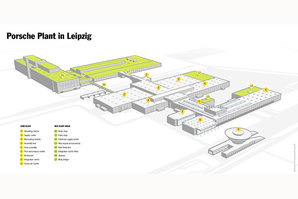
Bülow continues: “The expansion has now made Leipzig a full-fledged plant.” The Macan is produced in Leipzig with an even greater depth of production than the Cayenne and Panamera. That is because, unlike the two larger Porsche cars, the body of the new car is built and painted in Leipzig as well. To accomplish this, Porsche built a completely new body shop and a new paint shop on the production site – by lengthening the existing factory in a westerly direction. Simultaneously, Porsche Leipzig GmbH extended the factory by adding a separate supply centre for the body shop and enlarging the assembly hall. This has resulted in the following construction matrix – and at the same time a new sequence of the production steps – for the Porsche production site in Leipzig since 2014:
• Body shop supply centre. The aluminium and steel sheet metal – currently for the Macan – is produced at various Volkswagen Group press works and by external suppliers, and sheet metal parts are then delivered to Leipzig. In the new body shop supply centre, which has a floor area of around 10,000 square metres, the parts are electronically logged in and transported by tugger trains to the body shop.
• Body shop. On a floor area measuring 35,000 square metres, Porsche produces the body of the Macan in mixed aluminium-steel construction with around 6,000 welds. In their work, employees in the body shop are assisted by 387 industrial robots. One highlight is manufacturing of the complex aluminium bonnet design.
• Paint shop. The largest and most complex new building at the Porsche plant in Leipzig is the paint shop. On its multiple levels and floor area of 60,000 square metres, 81 robots paint the galvanised bodies of the Macan in one of the eleven standard colours currently offered – with cutting-edge efficiency and eco-friendly processes. Upon request – and this too makes Porsche the great brand that it is – a car may also be painted in any desired colour within the framework of the “Porsche Exclusive” customisation programme.
• Supply centre for assembly. Supplying an entire automobile factory with parts is a logistical master achievement. To supply these parts to the assembly lines with cyclic precision – without an intermediate warehouse – deserves even more respect. That is precisely how it is done in Leipzig. Because the Macan is now also assembled here, Porsche has doubled the floor area of the existing “assembly supply centre” (not to be confused with the new “body supply centre”) from 20,000 to 38,000 square metres. Around 4,500 different parts make their way into the assembly hall from here.
• Assembly. The Macan is now being added in the space where the Panamera and the Cayenne are assembled – in mixed production – on 21,600 square metres of floor area. From now on, instead of the previous maximum of 500 cars, up to 650 Porsche cars will be produced daily in three shifts on the “Door line”, “Interior lines 1 and 2”, “Underbody lines 1 and 2”, “Exterior lines 1 and 2”, “Mixed lines 1 and 2”, “Engine buildup”, “Chassis buildup”, the “Marriage” module and finally in the “Test area”. The last station before shipping or delivery to the Customer Centre is final inspection.
Test drive to validate top quality. At a testing area integrated in the final phase of assembly, the sport saloons and SUV are programmed, filled with fuel and started for the first time. Then the cars go out onto the run-in and test track: “Every Porsche in Leipzig – and this is a special aspect of this plant – is tested briefly before delivery. This is a process that is hardly the usual practice among the world’s car manufacturers, and it underscores the special position of the premium brand Porsche,” says Dirk Kolar, Head of Quality Assurance at Porsche Leipzig. In the first ten years of the plant’s existence – from August 2002 to June 2012 – 500,000 Cayenne and Panamera cars were produced in this way. By the end of December 2013, nearly 700,000 units of these two model series had been built. With the Macan, the milestone of one million vehicles produced in Leipzig is now approaching – in high-tech production that offers the same degree of customisation as handcrafting methods.
More articles of Overview
Milestones
- Plant opening for the first generation Cayenne in August 2002
- Production of the Panamera launched in April 2009