Porsche · digital presskit
Like open heart surgery
Porsche Leipzig still ran at full capacity while the plant was being expanded
- Porsche implemented the largest construction project of its history in less than 36 months
- Production floor area expanded from 79,900 to 245,900 square metres, costing 500 million euros
Series production and handcrafting. The Porsche plant in Leipzig is one of the world’s most advanced automobile factories. The Porsche Cayenne has been produced there since August 2002, and in September 2006 Porsche launched production of the Panamera as well. One special highlight of the Porsche brand is the fact that its innovative and precise industrial production of premium automobiles is associated with maximum handcrafting-like benefits in production. This means that cars are created on high-tech manufacturing systems in fully automated processes, but at the same time many Porsche cars are still ordered and built with such details as exclusive full leather trim on the instruments – features that assume a level of customisation on par with that of handcrafted cars. This wide range of production processes mastered at the Porsche plant in Leipzig also made it possible to produce the Porsche Carrera GT super sports car in a separate manufacturing area between 2004 and 2006. In 2010, the plant management in Leipzig began to entertain thoughts of potentially implementing production of the Macan.
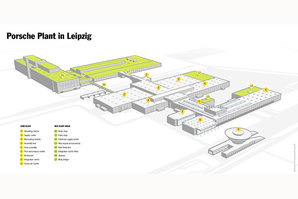
Assembly plant becomes comprehensive factory. On 15 March 2011, the Supervisory Board of Dr. Ing. h.c. F. Porsche AG, resolved to produce the new Macan in Leipzig in parallel with the Cayenne and Panamera. At the same time, a decision was made to expand the assembly plant with an investment volume of 500 million euros over the next three years, adding a new body shop and a new paint shop to expand it into a comprehensive factory. Its production area on the 946,979 square metre factory land site would be expanded from 79,700 to 245,900 square metres; the factory, Customer Centre and dedicated on-road and off-road test tracks would in turn be located on 4,000,000 square metres (400 hectares) of land owned by Porsche AG; its land area is larger than the former legendary Berlin Tempelhof airport (386 hectares).
Production site offers ideal expansion options. In a Group-wide solicitation for bids conducted before the production program, Porsche Leipzig GmbH was named the ideal site for production of the Macan. Various factors were cited as crucial in this decision: “The site has proven, in its production of the Cayenne and Panamera, that its highly qualified employees can manufacture highly complex products in top Porsche quality,” says Dr. Oliver Blume. The Member of the Executive Board for Production and Logistics at Porsche continues: “In addition, Leipzig has a strategically optimal location in the middle of Germany – it is a business node point with excellent transportation connections. In addition, we had and still have excellent expansion capabilities there.”
Made in Germany. The Executive Board not only voted for Leipzig in 2011; this also represented a vote for Germany as a production site. Matthias Müller, Chairman of Porsche AG comments: “For Porsche and its customers across the globe ‘Made in Germany’ is a key criterion. Here in Germany, there is an extremely high level of understanding for technology and innovative drive to continually improve processes. In addition, the great art of handcrafting is practiced in Germany, and this has traditionally been an important part of Porsche. Last but not least, in this country we have very well educated workers, and the qualification level in Germany is unique with its dual-track vocational training system. All of these parameters were important to us in making a decision as an automobile manufacturer to produce the Macan in Germany.”
Planning phase – how the plant expansion was conceptualised
Plant structural planning looks years ahead. The prerequisites for the plant expansion were already put in place in Leipzig long before the Macan was even discussed in the company’s long-term strategy papers. Siegfried Bülow, Managing Director of Porsche Leipzig GmbH and plant manager responsible for the expansion: “At the time the decision was made to produce the Panamera in Leipzig – which was in 2005 – we had already developed initial concepts of how the plant might appear in the years 2015 and 2020. A key aspect here is what is known as plant structural planning – this master plan is used to get an early glimpse of the future of the factory. It involves planning an imaginary additional model series to be produced. We did this in 2005 without knowing that there would be a Macan. From this perspective, the current expansion is essentially a planned extension of the factory.”
The first step towards becoming a comprehensive factory. One member of Siegfried Bülow’s team is Christoph Beerhalter, Head of the Macan Project. As a production specialist his job was to work together with the local plant manager to create real production systems from the theoretical plans for the plant expansion. Beerhalter: “In plant structural planning, one considers how the white areas on the production site might look built up in the year 2020. And then one knows where to place which systems so that the plant is set up to handle future needs – i.e. it offers long-term development and growth potential. Plant structural planning is the first step!” Siegfried Bülow adds this: “It is precisely at this point that one can make the biggest mistakes. If we had not done our work properly back in 2005 – when the decision was made to produce the Panamera – and had not thought beyond the Panamera in designing our plant structures and extensions – we never would have been able to follow through on these extensions for the Macan.”
Construction phase – how the plant expansion was implemented
166,000 square metres of additional production floor area. Christoph Beerhalter, head of the plant expansion team: “We started with a factory here in 2002 that originally had a floor area of 14,400 square metres. During the current expansion – simply due to adding production of the Macan – new buildings had to be constructed that cover nearly twelve times this area.” A total gross floor area of 166,000 square metres had to be created – an interior floor area that is 1.4 times larger than the new “Elbe Philharmonic” concert hall in Hamburg. Just to excavate for the foundations of the new factory buildings and modify relevant surfaces of the land site, 20,600 lorry loads had to be moved – that is 515,000 cubic metres of soil. A graphic comparison: this volume is also larger than the total space enclosed by the 110 metre tall concert hall in Hamburg. Expressed in automotive terms, the amount of earth moved in Leipzig is equivalent to the total volume of over 35,225 new Porsche Macan cars.
Perfect interplay of city and country. After the resolution of 11 March 2011 to produce the Macan in Leipzig, everything proceeded very quickly. The primary reason for this is that from the very start Porsche Leipzig GmbH coordinated everything very closely with all approval authorities of the city of Leipzig and the state of Saxony. When this close cooperation is lacking, construction projects of this magnitude can quickly experience schedule delays. Christoph Beerhalter gives an example: “An approval related to the federal emissions protection law – which is needed before any building activities or erection of a vehicle plant can begin – is not a type of approval that a city can issue. Rather an independent approval agency is involved which demands strict adherence to the various conditions of this law.” Beerhalter continues: “It is necessary to coordinate precisely with the authorities to ensure that no dates are missed. A council meeting does not happen every week, rather just once per month. And if you miss that meeting, you have lost one month. That is why we at Porsche joined together with representatives of the city of Leipzig, the state of Saxony and approval agencies to form a steering group, whose goal is to simply handle all issues and flows related to the project with extremely close coordination.”
More articles of Expansion phase