Porsche · digital presskit
Creating the supply centres and extended assembly area in detail
Assembly area extended, supply centres doubled in size.
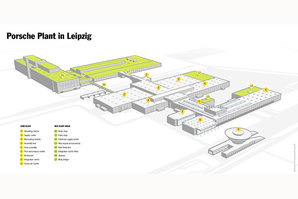
Over the same time period, between autumn 2011 and late summer 2013, an entirely new supply centre was built for the body shop, the supply centre for assembly was built, and the assembly area itself was extended. Another milestone of the factory was construction of the “body shop supply centre” which is 280 metres long and 36 metres wide.
It was connected directly to the longitudinal side of the body shop to assure short and quick paths for supplying the facility. Michael Weihrauch of the Logistics area at Porsche Leipzig GmbH: “The building with its 10,000 square metres of floor area was designed so that, after unloading from the lorries, the delivered steel and aluminium sheet metal parts for the new Porsche Macan could be transported from the body shop supply centre without forklifts despite the significant sizes of some of these sheet metal parts.”
Six bays for parts delivery. A technical prerequisite for doing without forklifts in the buildings was met by implementing a special conveying system that utilises tugger trains with rolling containers. The containers, each of which may weigh as much as 800 kg, are all pushed manually from the tugger train to the production station using an ergonomic handling technology developed by Porsche. The cargo carriers are delivered to the new supply centre by lorry. This is done via a perfectly designed receiving dock system with six bays. Up to six lorries can be unloaded into the bays by forklifts here; this is all done within an action radius of just a few metres, and the cargo carriers are immediately transferred to the tugger trains. As mentioned, there are no forklifts in the building itself, so this factory can really be described as the world’s first “forklift-free” automobile factory.
Assembly supply centre now has nearly twice the area. Naturally, this also applies to the expanded “assembly supply centre”. Until now, this logistics centre supplied the assembly area with parts for the Cayenne and Panamera. Now, the area had to be significantly enlarged for the third Porsche model series from Leipzig. Michael Weihrauch explains: “We nearly doubled the floor area of the assembly supply centre from 20,000 to 38,000 square metres.” Two sides of the original supply centre were lengthened. Here too, Porsche ensured that the logistics chain would operate perfectly from the very start. Weihrauch: “There are three large freight entrances; this is where the lorries are unloaded. Forklifts transfer the material directly onto tugger trains. These tugger trains distribute the materials – without the use of forklifts – directly into the pick-and-place zones or supermarkets.” Like the assembly area, this supply centre was extended and retrofitted while production of the Cayenne and Panamera was running at high speed. Plant manager Siegfried Bülow: “In a sense, this expansion of the supply centre and assembly areas was similar to open heart surgery.” Michael Weihrauch explains how operations were run at the supply centre: “Naturally, the top priority of logistics is to ensure a stable supply of materials to production. That is why we completely restructured the supply centre; this was accomplished by a tremendous effort spanning a time period of just twenty weeks – Tetris with Porsche parts.” To be exact, the total number of parts was 4,500 at full start-up of the Macan.
Capacity for up to 650 new Porsche cars daily. These parts are assembled on the production lines of the assembly hall which now has 49,200 square metres of floor area (not including intermediate levels or decoupling modules). The lines had to be supplemented with cycles specific for the Macan here – stations at which individual parts and modules are assembled in and on the cars – and numerous stations had to be modified. This applies in particular to the chassis and engine build-ups, which is the term used by production experts for assembly of the suspensions, exhaust systems and engines. The lines were also made longer overall. An entire line was added for the Macan in what is known as the testing area – among other tasks performed in this area, the vehicles’ control units or computers are supplied with data (“parameterised”), and the engines are started for the first time. Once again, Christoph Beerhalter: “Lines were in fact lengthened, new equipment was brought in, equipment was redesigned, and lines were made faster. In the assembly area alone, we are talking about an investment of 40 million euros for new production equipment. Before the expansion of the Porsche plant in Leipzig a maximum of 500 Cayenne and Panamera vehicles were produced daily in the assembly area and shipped to the 120 countries in which Porsche has a presence. From now on, with the Macan, up to 650 new Porsche cars can be made in Leipzig every day.
More articles of Expansion phase