Porsche · digital presskit
How the body shop was created in detail
Body manufacturing on 35,000 square metres.
Just for body manufacturing, 90 binders of documentation were generated – they were filled to the brim with many different approvals. They contained noise, air and fire reports, safety strategies and various other study results.
By 14 June 2012 – just 15 months after Leipzig was selected – the topping-out ceremony was held for the 35,000 square metres body shop. The building itself is so large that it is better to ride a bicycle to get from one end to the other. It is 288 metres long and 120 metres wide. There is just one floor space, but it has a tremendous height of ten metres from floor to ceiling. On 1 September 2012, around 10 weeks after the topping-out ceremony, the first systems had already been installed for the Macan that was to be produced in mixed aluminium-steel construction – this effort also involved installing the first of the 387 robots in the body shop – they were sourced primarily from the German specialist Kuka.
Floor modules define distribution. Exactly where specific body parts are joined together is defined by the floor modules that were placed beforehand. Christoph Beerhalter: “When you assemble a car, there is always a certain sequence to be followed. That is, I produce the underbody structure, followed by the side sections and the roof, and finally the doors and lids come into play, and – expressed in very simplified terms – the whole body is finished.” Beerhalter continues: “If I know precisely how the vehicle should look, which individual parts it should have, precisely how it should be constructed, what challenges it poses, then I can plan the equipment precisely. Take the underbody, for example. Here, I know that it consists of a defined number of underbody structures, which are in turn created from parts that are defined just as precisely and which are joined by specific joining technologies. New aspects may enter the picture such as the elaborately constructed bonnet made of aluminium; this then leads to another large change in the floor modules. However, the modifications are narrowed progressively – and at some point this leads to fewer and fewer corrections. In the end, the facility assumes a specific physical form in steel and with all of its robots and computers.”
How the paint shop was created in detail
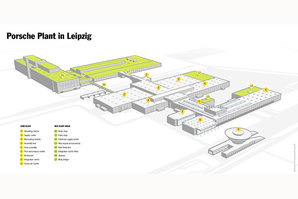
Second paint shop at Porsche. The largest new building of the Porsche plant in Leipzig is the paint shop. It is located in the southern-most section of the factory, right next to the body shop. Like the body shop, the paint shop was specifically built for production of the Macan. Theoretically, however, almost any other Porsche could be painted here as well.
As long as the pit row on the Nürburgring race course. The paint shop has a floor area measuring 20,000 square metres – enough space to (theoretically) park 6,400 Macan cars bumper to bumper. At a length of 360 metres, the paint shop is nearly as long as the entire pit row at the start/finish lines of the Nürburgring race course, and it is 15 metres longer than the Queen Mary 2 luxury liner. The building is 72 metres wide and 32 metres tall. Its gross interior space is 650,000 cubic metres – this too is larger than the whole interior of the new Elbe Philharmonic concert hall in Hamburg. Purifying the air in the painting area requires an enormous effort. Porsche has implemented an innovative wet-chemical method here, which was installed on the upper floor of the paint shop. 2.3 million cubic metres of air is moved per hour in the paint shop – that is 34 times the volumetric flow rate of ventilation air that is circulated in the assembly chamber of the German Reichstag building in Berlin, which definitely has a significant amount of space.
Simultaneous external and internal expansion. “During its construction, the size and complexity of the paint shop led to an even more ambitious schedule than was the case for the body shop. Nonetheless, we were able to integrate this timeline into the overall time window,” says Siegfried Bülow, Managing Director of the Porsche Leipzig plant. Bülow continues: “We were able to achieve this, because the team succeeded in intermeshing construction of the building and the process of setting up the equipment systems inside. That is, we had already begun to install the first system areas while the building construction work was still being completed.”
Paint shop was built in less than 24 months. In October 2011 – just five months after the decision to produce the Macan in Leipzig – excavation work had already begun, i.e. digging for the foundation. On 14 November, work began on the bored pile foundation; this involved sinking 221 bore piles up to 37 metres deep with 5,500 cubic metres of concrete to support them on very stable underground layers, so that building loads could be optimally distributed in conjunction with the foundation. That is because, despite efforts aimed at boosting efficiency and sustainability in operating the facility, the building itself is still a rather heavyweight object. The installed steel bored piles themselves and the concrete they required weigh 13,825 metric tonnes – that is equivalent to the weight of 36 Airbus A380 airplanes (during landing). Work started on the shell of the three-story paint shop on 19 March 2012. Less than four months later, on 4 July, construction workers had already made their way onto the second floor, nine metres above the ground. Another four months later, on 6 November, Porsche celebrated the topping-out ceremony for the paint shop. Incidentally, the prefab concrete elements installed in the paint shop weighed 40,000 metric tonnes, and the total amount of installed concrete was 113,000 metric tonnes. The latter is equivalent to the landing weight of 292 Airbus A380 airplanes. As mentioned, systems were built inside the building towards the end of the construction phase, and on 15 August 2013 the first Macan body was painted in a test. Less than 24 months had elapsed from the start of construction in October 2011 until the first car body was painted. This was a record time for erecting one of the most advanced paint shops in the world.
More articles of Expansion phase