
Porsche · digital presskit
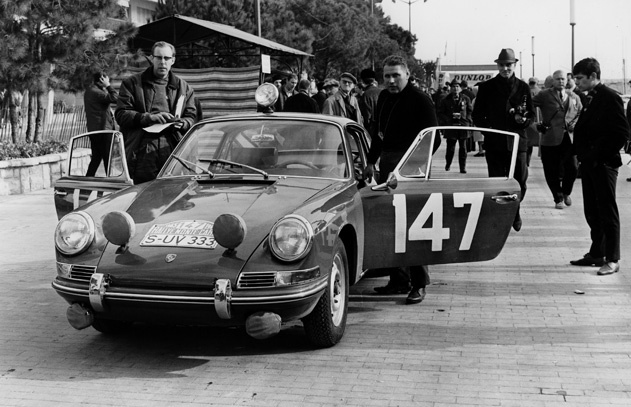
Many of the ideas and technologies used for the first time in the Porsche 911 have their origins in motorsport. After all, the 911 was always dedicated to the principle of high performance and motor racing was its most important testing ground. From the outset it was a regular participant on racetracks and rally circuits all over the world and proved itself a multifaceted and reliable winning vehicle. Yet the 911 was seldom the most powerful car in the field. It was, however, always the most efficient. Typically Porsche, in fact.
A good two thirds of what are now around 30,000 victories for Porsche are down to the 911. That’s no surprise, as F. A. Porsche’s stroke of genius shows inexhaustible potential for technical development not just for road use, but in motorsport as well. With rear or mid-mounted engine, with or without turbocharger, with all-wheel or rear-wheel drive, in classic trim or extremely streamline carbon fibre outfit, the 911 became and remains a regular on the list of winners of the world’s greatest races and rallies.The cooperation with client teams is of great importance to Porsche. This strategy has proved its worth since the early days, with the factory leading the way as the innovative force and the clients then benefiting directly from the research and development and work. In return the clients’ successes have contributed to the winning of numerous major championships.
The trail of success began in 1965: at the Monte Carlo Rally, made extremely difficult by bad weather, the Porsche 911 2.0 proved its qualities in top international motorsport for the first time. After 4,600 kilometres, often in driving snow, no more than 22 of the 237 vehicles to start made it to the finish. Porsche employees Peter Falk and Herbert Linge completed the rally with victory in their class and an outstanding fifth place in the overall rankings. With a 100-litre petrol tank, shorter gearing ratio, differential lock and sports suspension, this 911 was excellently equipped for rallying. In 1966, four 911 cars took the first four places in the Gran Turismo classification. In 1967, a 911 S works car won the two-litre class at the Targa Florio. British all-round talent Vic Elford took the European Championship with the 911 S 2.0 ‘Rallye’.
In 1968, Vic Elford secured the first overall victory for Porsche at the Monte Carlo Rally. In 1969 and 1970, Björn Waldegård repeated the feat, with 180 horsepower (132 kW) from a 2.2-litre engine already available to the Swede for his 911 S, which weighed in at just 960 kilograms. In 1978, Frenchman Jean-Pierre Nicolas, driving a privately entered three-litre Carrera RS, beat off every works team in the snow-induced chaos and gained what for a while would be the last overall victory for Porsche at the classic rally in the French Maritime Alps.
The reliability and speed of the Porsche 911 was underlined by numerous other rally successes. In 1966, Günther Klass won the European Championship in a 911 and in 1967 Sobieslaw Zasada was successful with a 911 S (and a 912) in Group 1 (for cars with only minor modifications), while Vic Elford won Group 3 for more highly modified GTs. In 1968, the European Champion was Pauli Toivonen and his car was a 911 T. At that time, the European Championship was the highest-ranking rally championship in the world, with its gruelling races, such as the Monte Carlo Rally, the Austrian Alpine Rally, the Rally of Sweden and the San Remo Rally, placing extreme demands on the drivers and their cars. The Porsche 911 won them all – some more than once. In 1970, the Porsche works team with Björn Waldegård won the international one-cup championship – the forerunner of the World Rally Championship.
More articles of 911: In Motorsport
- The Porsche 911 in motorsport
- Success on the track: the triumphal procession of the 911 in the GT categories
- 1972: The 911 Carrera RS 2.7 begins its legendary career
- 1974: 911 Carrera RSR 2.1 Turbo – the first turbocharged race car
- 1978: ‘Moby Dick’: mixed cooling and 366 km/h
- The 1990s: renaissance of the GT racing cars
- 1996: 911 GT1 - the first mid-engine 911
- 2010: 911 GT3 R Hybrid almost causes a sensation