
Porsche · digital presskit
Success on the track: the triumphal procession of the 911 in the GT categories
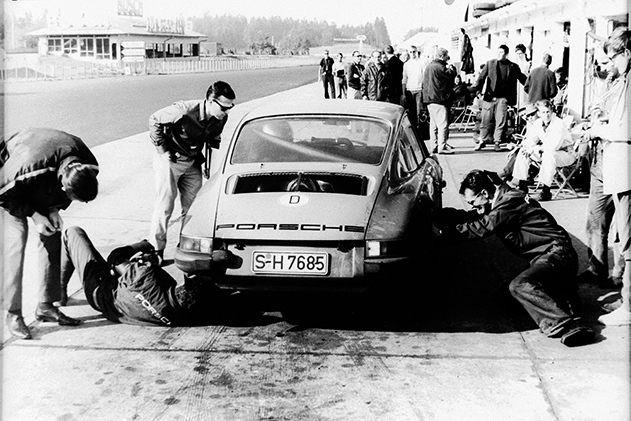
However, even more clearly than in rallying the 911 dominated on the racetrack, where mid-engine racing cars, such as the 904 Carrera GTS, the 906 Carrera 6, the 908 and the legendary 917 initially took overall victories and titles, while the 911 began its run of success in the GT (Gran Turismo, Grand Touring) categories.
As early as 1966, Porsche clients were already achieving internationally significant successes with the 911 S, including a win in the two-litre class at the 24-hour race in Daytona achieved by Jack Ryan and Art Benker and the first class victory at Le Mans by ‘Franc’ and Jean Kerguen. In 1967, clients picked up 13 national titles in the categories for modified production cars, including a championship in the major American TransAm, where the 911 was champion’s car in 1968 and 1969 as well. The 911 won in its class at Daytona, Sebring, Spa, in the Targa Florio and on the Nürburgring. The first overall victory in the 24-Hours of Spa came as soon as 1967, with the Porsche teams completing the hat-trick in 1968 and 1969.For works use and client motorsport Porsche produced in 1967 the limited edition 911 R. The prototype had a Carrera 6 engine delivering 210 hp – ample power for a weight of just 830 kilograms. Driving the new car, Vic Elford, Hans Herrmann and Jochen Neerpasch immediately won the ‘Marathon de la Route’, an 84-hour race on the Nürburgring – the new, semi-automatic ‘Sportomatic’ gearbox also survived the torture without complaint. That November in Monza the car set numerous world speed records.
In 1970, the motorsport division built for works driver Gérard Larrousse the lightest 911 ever to be licensed for use on the road: the 911 ST for the Tour de France weighed in at all of 789 kilograms. Legend has it that Larrousse promised the mechanics a crate of champagne for every kilo below the 800-mark… Larrousse came third – beaten only by two Matra prototypes.
Until 1972, the Porsche 911 S, 911 R and 911 T remained the cars to beat. The 911 S 2.3 of 1971 had a power output of 240 hp. One year later, a flat engine increased in size to 2.5 litres was already producing 270 horsepower. It was almost impossible to keep track of all the victories and titles, with the winning of the GT European Cup in 1971, 1972 and 1973 being the standout achievements.
In 1972, based on the RS 2.7, Porsche Motorsport built the 911 Carrera RSR 2.8 for use in several series, including the one-cup world championship. Among 911 lovers it has been one of the most admired models ever since. The RSR 2.8 weighed just 890 kilograms, while its six-cylinder engine, enlarged by 100 cc, delivered around 300 hp (221 kW) – 90 hp more than the RS 2.7. The chassis was largely the same as on its predecessor, though the brake system was made even more powerful. The very first appearance of the 911 Carrera RSR 2.8, at the 24 Hours of Daytona in 1973, was a triumph, as Peter Gregg and Hurley Haywood achieved overall victory against far more powerful GTs and prototypes. Gregg and Haywood, this time joined by Dave Helmick, won the second great US classic, as well: the 12-hour race in Sebring. At Le Mans a works RSR, finishing behind three prototypes, only just missed out on the podium. Another outstanding achievement was the victory at the final Targa Florio in 1973, when Herbert Müller and Gijs van Lennep in an RSR completed the race, which counted towards the one-cup world championship, in the fastest time and thus secured the eleventh overall win for Porsche.
For the 1974 season there followed in the shape of the Carrera RSR 3.0 an even more powerful version for the racetrack with a 2,994 cc engine that output 330 hp (243 kW). Exclusively designed for racing, the RSR 3.0 featured a distinctive large rear tail and very broad wings. Porsche easily won the GT European Championship and practically all other significant GT championships of that year.
Leading the development of the 911 in racing trim was engineer Norbert Singer, who would later be responsible, among other achievements, for the legendary 935 and the 956/962C. Responsible for the race and rally engines was Hans Mezger, the father of the 911 engine.
In the 1974 FIA GT European Cup the first eight places went to Porsche. Clients running the 911 also won the IMSA and TransAm championships in the USA. A year later, Carrera RSR cars occupied all top ten places in the GT European Championship. Client teams won numerous national championships as well.
Even as the RSR was still racing from success to success with naturally aspirated engines, Porsche was working flat out on a turbo drive system, aimed at making the 911 capable of overall victory in the top categories of future championships. Porsche had already had experience in 1972 and 1973 with the turbocharged 12-cylinder engine of the 917, which as the 917/30 delivered up to 1,400 hp (1,029 kW) and dominated the CanAm race series.
More articles of 911: In Motorsport
- The Porsche 911 in motorsport
- Success on the track: the triumphal procession of the 911 in the GT categories
- 1972: The 911 Carrera RS 2.7 begins its legendary career
- 1974: 911 Carrera RSR 2.1 Turbo – the first turbocharged race car
- 1978: ‘Moby Dick’: mixed cooling and 366 km/h
- The 1990s: renaissance of the GT racing cars
- 1996: 911 GT1 - the first mid-engine 911
- 2010: 911 GT3 R Hybrid almost causes a sensation