
Porsche · digital presskit
The 1990s: renaissance of the GT racing cars
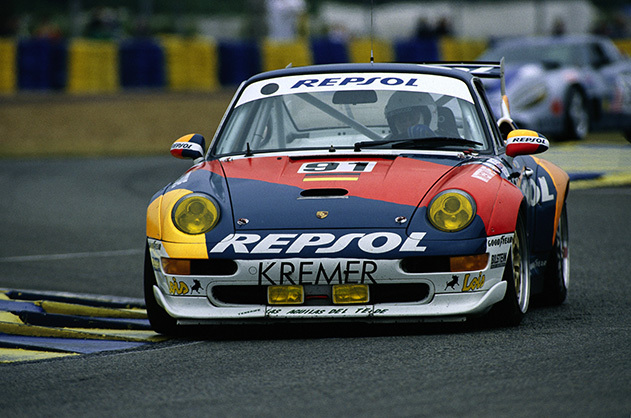
With the end of the spectacular prototypes such as the 962 C, the sport experienced a renaissance at the start of the 1990s with Gran Turismo racing cars more or less unmodified from the production models. Porsche supported this trend with numerous developments of the 911 tailored to the respective countries and race series.
In the USA the 911 Turbo dominated the IMSA Supercar Championship from 1991 to 1993. Also in 1993, numerous client teams celebrated the 30th birthday of the 911 in their own way. Driving a Turbo S Le Mans GT, with a 3.16-litre twin-turbo, 474 hp (348 kW) and unladen weight of 1,000 kilos, the ‘Dream Team’ of Röhrl/Stuck/Haywood won in their class at Sebring. A Carrera RSR 3.8 with a 3.8-litre naturally aspirated engine and 350 hp (257 kW) was the first GT waved across the line at the 24 Hours of Le Mans. In the Nürburgring 24-Hour Race the RSR 3.8 was also unbeatable, leading three further 911 cars over the finishing line – making it the first time in the history of the race that four cars of the same make had taken the first four places. This GT racing car also made the headlines with overall victory in the 24 Hours of Spa-Francorchamps.In 1995, the success story of the 911 continued in impressive style. The magic word now was predominantly the 911 GT2, with which a privateer team clearly won the BPR Endurance Championship, while US client teams comfortably won both the SCCA World Challenge and the IMSA Exxon-Supreme GTS2 Championship in the USA. The list of successes is simply endless, containing such prestigious further championships as the ADAC GT Cup and the All Japan GT Championship. As successor to the RSR 3.8 the 911 GT2 R produced from a 3.6-litre twin-turbo engine initial power output of 450 hp (330 kW). Depending on the rules of the different championships this could be increased to around 485 hp (345 kW). As the 911 GT2 Evolution for the highest GT category (GT 1) this racing sports car could even mobilise 600 hp (442 kW).
More articles of 911: In Motorsport
- The Porsche 911 in motorsport
- Success on the track: the triumphal procession of the 911 in the GT categories
- 1972: The 911 Carrera RS 2.7 begins its legendary career
- 1974: 911 Carrera RSR 2.1 Turbo – the first turbocharged race car
- 1978: ‘Moby Dick’: mixed cooling and 366 km/h
- The 1990s: renaissance of the GT racing cars
- 1996: 911 GT1 - the first mid-engine 911
- 2010: 911 GT3 R Hybrid almost causes a sensation