
Porsche · digital presskit
1972: The 911 Carrera RS 2.7 begins its legendary career
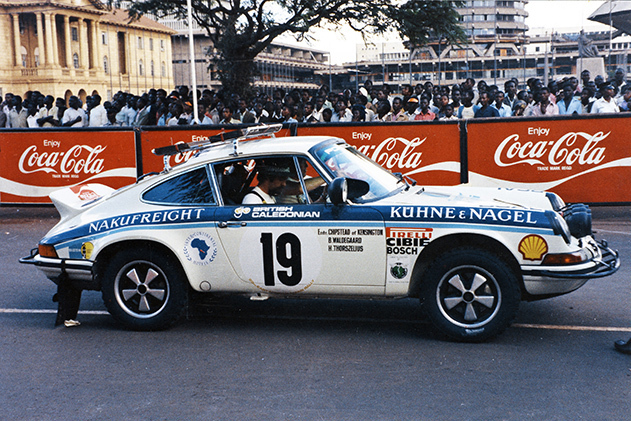
In launching the 911 Carrera RS 2.7, Porsche introduced in 1972 one of the world’s most successful GT sports cars – and one of the style icons of sports car design. ‘Ducktail’ was the buzzword, the famous spoiler on the engine compartment hood.
The RS 2.7 was the first 911 with the suffix ‘Carrera’ and also the first with differing tyre sizes on front and rear axle. The 210 hp (154 kW) Porsche, weighing 1,075 kilos and doing 245 km/h wowed the market: while initially just a production run of 500 for homologation in motorsport was planned, Porsche ultimately sold over 1,500 units of the high-performance sports car. At the East African Rally in 1973 and 1974, the RS 2.7 missed out on overall victory due only to ‘minor faults’ and took second place. In 1974, Porsche drivers in the RS 2.7 had numerous successes, including winning the German Rally Championship. For use on asphalt racetracks the motorsport department created a motoring gem with the name 911 Carrera 2.8 RSR.At the East African Safari Rally of 1978 Vic Preston and Björn Waldegård set off in two Porsche 911 SC cars on the 5,000 kilometres of ongoing torture. After leading for a long time, they ultimately came home second and fourth.
In 1981, double rally world champion Walter Röhrl wrote his name into the history books as, in his rear-wheel drive 911 SC 3.0, he fought a breathtaking battle with the all-wheel drive Audio Quattro on the San Remo Rally – and missed out on what seemed set to be victory just short of the finishing line with a broken drive shaft.
At the end of 1983, Porsche brought out the limited edition 911 SC RS. Based on the 911 SC this car, known internally as the ‘954’, had a three-litre naturally aspirated engine, which in rally trim produced 250 hp (184 kW). Its unladen weight was just 1,057 kilograms and like all 911 models, this rear-wheel drive car also had outstanding traction. Porsche clients began winning with the 911 SC RS right away, including the Middle East Rally Championship in 1984.
In that same year, Porsche won for the first time at the Paris-Dakar Rally. In what is the world’s toughest marathon René Metge drove a 911 Carrera 4x4 (Type 953) into first place. It was the first victory by a grand tourer at the ‘Dakar’, which until then had been dominated by specially prepared all-terrain vehicles. The first ever all-wheel drive 911 was powered by a standard 3.2-litre engine with reduced compression and 225 hp (165 kW). Special features on the Type 953 included a fully lockable centre differential and a double wishbone front axle, plus two shock absorbers on each side. Two fuel tanks held a total of 270 litres of petrol.
In 1985, Porsche picked up no trophies from a first trial run at the ‘Dakar’ with the pioneering 959, but gained important technical insights and won with the all-wheel drive car that same year at the Pharaohs Rally in Egypt. In 1986, the 959 came up trumps at the Paris-Dakar - the toughest ever in the rally’s history. Of over 280 cars at the start no more than 31 completed the 13,800 gruelling kilometres through the Sahara. The sports car, with innovative, electronically adjusted chassis and all-wheel drive, plus, thanks to a sequential twin-turbo, engine power of around 400 hp (294 kW), scored a triumphal one-two victory: René Metge ahead of Jacky Ickx. Even the third 959, entered as a ‘racing workshop’, with project leader Roland Kussmaul at the wheel made it into the top 10, finishing in sixth place. It was thus a total success in this test of strength for the 959, which in its road car form fascinated fans of vehicle technology all over the world.
More articles of 911: In Motorsport
- The Porsche 911 in motorsport
- Success on the track: the triumphal procession of the 911 in the GT categories
- 1972: The 911 Carrera RS 2.7 begins its legendary career
- 1974: 911 Carrera RSR 2.1 Turbo – the first turbocharged race car
- 1978: ‘Moby Dick’: mixed cooling and 366 km/h
- The 1990s: renaissance of the GT racing cars
- 1996: 911 GT1 - the first mid-engine 911
- 2010: 911 GT3 R Hybrid almost causes a sensation