
Porsche · digital presskit
1974: 911 Carrera RSR 2.1 Turbo – the first turbocharged race car
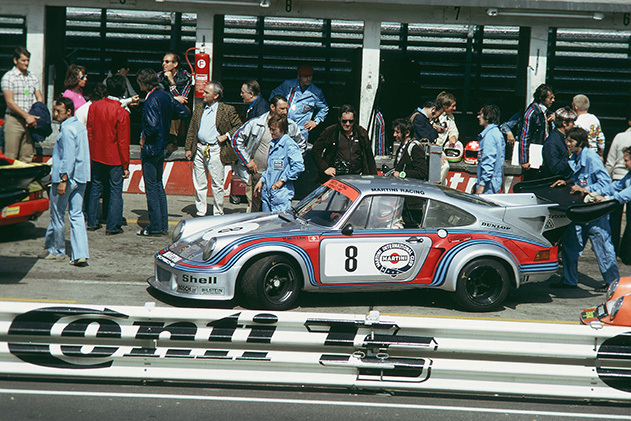
The engine delivered output of around 500 hp (368 kW) and in the race twice around the clock it proved itself superbly. Weighing just 825 kilograms, with a huge rear wing and extreme widening of the body for the rear wheels from the 917, the Porsche finished in second place – a race car based on the production model thus broke into the phalanx of the hollow frame prototypes with their Formula 1 engines.
Overall victory would have been possible, as the leading Matra was stuck in the pits on the Sunday morning with a gearbox problem. However, two top mechanics from Porsche repaired the fault in record time and rescued the win for the French. The reason they did so was that the Matra gearbox was one developed by Porsche.The 911 Carrera RSR 2.1 Turbo was the forerunner of the 934 and 935 models, which were developed based on the 911 Turbo (930) road car and were used from 1976 in the one-cup world championship and many national championships. Closer in engineering terms to the road car was the 934. The chassis and aerodynamics were largely the same as on the production model, while the brake system came from the 917. A turbocharger helped the three-litre engine to produce a good 485 hp (357 kW). By increasing the charge pressure, client teams were soon achieving a steady 580 hp and were in an untouchable class of their own as they competed for the GT European Championship in the Group 4 category for modified production cars. In the USA the 934 won the TransAm.
The Group 5 category allowed more far-reaching modifications to the base vehicle, as long as the original silhouette was retained. Type 935 racing sports cars became the benchmark here. Initially delivering around 590 hp (434 kW) and with its unique front section, the car weighed 970 kilograms (with 70 kilograms of lead ballast). At the start of 1976, the headlights still stood upright. As, however, the rule book allowed free design of the front wings, Norbert Singer removed the headlight domes and smoothed the front down, which improved aerodynamics in racing use. This ‘flat nose’ version was unveiled in 1977, with the headlights then situated in the front spoiler. With works drivers Jacky Ickx and Jochen Mass, Porsche immediately won the 1976 World Championship for Manufacturers and returned to the championship the following year. Now with a twin turbocharger and around 630 hp (463 kW), the 935 again took the title, with not only the works team but also highly professional client teams successfully picking up points.
In the late seventies, the DRM German Racing Championship was run in two divisions for vehicles with engine capacity of up to and over two litres. From 1977 to 1979, Porsche clients won the championship in the ‘top’ division. In 1977, the factory entered the 935/2.0 ‘Baby’ on a trial basis in the very popular ‘lower’ division. It had a 1.4-litre turbo engine, which when calculating in the ‘Turbo factor’ remained at just under 2,000 cc. The power train delivered 380 hp (279 kW). The extremely lightweight construction methods led by Norbert Singer were so successful that the team had to put 25 kilograms of lead ballast in the front of the car in order to achieve the required minimum weight of 750 kilograms. The ‘Baby’ went down in history as the lightest 911 ever built – and won the DRM race at Hockenheim half a lap ahead of the competition.
More articles of 911: In Motorsport
- The Porsche 911 in motorsport
- Success on the track: the triumphal procession of the 911 in the GT categories
- 1972: The 911 Carrera RS 2.7 begins its legendary career
- 1974: 911 Carrera RSR 2.1 Turbo – the first turbocharged race car
- 1978: ‘Moby Dick’: mixed cooling and 366 km/h
- The 1990s: renaissance of the GT racing cars
- 1996: 911 GT1 - the first mid-engine 911
- 2010: 911 GT3 R Hybrid almost causes a sensation