
Porsche · digital presskit
1996: 911 GT1 - the first mid-engine 911
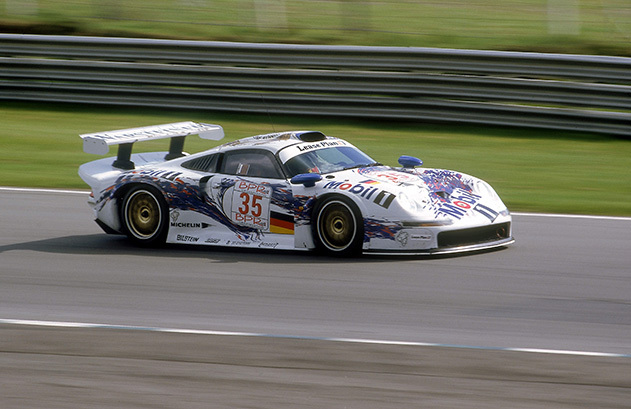
The body was made of carbon fibre / Kevlar. Weighing 1,050 kilograms, the car performed superbly against the prototypes and took both second and third places in the overall final standings at Le Mans, with Porsche clearly winning the GT class. A year later, Porsche was back at Le Mans with the 911 GT1 Evolution. The cars featured optimised aerodynamics, modified chassis and enhanced engine management. However, both GT1 Evo cars retired shortly before the finish. For later outings in the FIA GT Championship the vehicle had the first sequential gearbox in a racing car based on the 911.
Clients came up trumps with the 911 GT2 in 1996 as well, with successes including class victories at Le Mans, Daytona and Sebring. The SCCA World Challenge and the BPR Endurance Championship also went once again to the Porsche teams and drivers. In 1997, client teams running the 911 GT2, 911 GT2 Evo and 911 GT1 seamlessly continued the great achievements of the previous year.
By 1998 the time had come: with a once again greatly modified 911 GT1 – the first Porsche racing car with a carbon fibre monocoque – the Porsche works team secured a one-two win at Le Mans to coincide precisely with the company’s 50th anniversary. Clients all over the world continued to achieve success with the GT2 and GT1 Evo. Highlights included victories in the GT1 and GT2 classes at Daytona and the GT2 victory at Sebring. The works team finished the season in second place in the FIA GT1 Constructors’ Championship.
Lining up at the start at Le Mans in 1999 was the brand new 911 GT3 R with a fully water-cooled engine. 415 hp (305 kW) was produced by the 3.6-litre flat engine, with which a works-backed independent team immediately won in their class. Running the race versions of the GT3 R, the RS (from 2002) and the 455-hp (335 kW) GT3 RSR (from 2004), Porsche clients – some backed by the factory – won ten drivers’ and eight team championships in the GT class of the American Le Mans Series (ALMS) between 1999 and 2010. In the American GrandAm too the GT3 was for a long time almost unbeatable. From 1999, Porsche drivers won seven driver’s titles, six team titles and eight manufacturer’s crowns. Porsche clients enjoyed similar success in the FIA GT Championship and in numerous national championships.
Following the victorious debut in 1999, came eight further class wins against strong competition for the GT3 R, RS and RSR in the years up to 2010. At the 24-hour race in Daytona in 2003, a 911 GT3 RS repeated the coup of 1973 – a modified Porsche production car again beat the prototypes and took overall victory. On the Nürburgring as well, the world’s most demanding circuit, the 911 GT3 proved its potential. Four overall wins in succession were achieved here from 2006 (GT3 MR) to 2009 (all GT3 RSR). In 2011 came the latest overall win by a 911 GT3 RSR in the ‘Green Hell’.
Clients came up trumps with the 911 GT2 in 1996 as well, with successes including class victories at Le Mans, Daytona and Sebring. The SCCA World Challenge and the BPR Endurance Championship also went once again to the Porsche teams and drivers. In 1997, client teams running the 911 GT2, 911 GT2 Evo and 911 GT1 seamlessly continued the great achievements of the previous year.
By 1998 the time had come: with a once again greatly modified 911 GT1 – the first Porsche racing car with a carbon fibre monocoque – the Porsche works team secured a one-two win at Le Mans to coincide precisely with the company’s 50th anniversary. Clients all over the world continued to achieve success with the GT2 and GT1 Evo. Highlights included victories in the GT1 and GT2 classes at Daytona and the GT2 victory at Sebring. The works team finished the season in second place in the FIA GT1 Constructors’ Championship.
Lining up at the start at Le Mans in 1999 was the brand new 911 GT3 R with a fully water-cooled engine. 415 hp (305 kW) was produced by the 3.6-litre flat engine, with which a works-backed independent team immediately won in their class. Running the race versions of the GT3 R, the RS (from 2002) and the 455-hp (335 kW) GT3 RSR (from 2004), Porsche clients – some backed by the factory – won ten drivers’ and eight team championships in the GT class of the American Le Mans Series (ALMS) between 1999 and 2010. In the American GrandAm too the GT3 was for a long time almost unbeatable. From 1999, Porsche drivers won seven driver’s titles, six team titles and eight manufacturer’s crowns. Porsche clients enjoyed similar success in the FIA GT Championship and in numerous national championships.
Following the victorious debut in 1999, came eight further class wins against strong competition for the GT3 R, RS and RSR in the years up to 2010. At the 24-hour race in Daytona in 2003, a 911 GT3 RS repeated the coup of 1973 – a modified Porsche production car again beat the prototypes and took overall victory. On the Nürburgring as well, the world’s most demanding circuit, the 911 GT3 proved its potential. Four overall wins in succession were achieved here from 2006 (GT3 MR) to 2009 (all GT3 RSR). In 2011 came the latest overall win by a 911 GT3 RSR in the ‘Green Hell’.
More articles of 911: In Motorsport
- The Porsche 911 in motorsport
- Success on the track: the triumphal procession of the 911 in the GT categories
- 1972: The 911 Carrera RS 2.7 begins its legendary career
- 1974: 911 Carrera RSR 2.1 Turbo – the first turbocharged race car
- 1978: ‘Moby Dick’: mixed cooling and 366 km/h
- The 1990s: renaissance of the GT racing cars
- 1996: 911 GT1 - the first mid-engine 911
- 2010: 911 GT3 R Hybrid almost causes a sensation